Pages

Orthodox Convent in Bethany being intimidated by criminals and Islamists

Senin, 22 Juli 2013

Related to this article and interview.

Pravoslavie.ru - Bethany, July 18, 2013


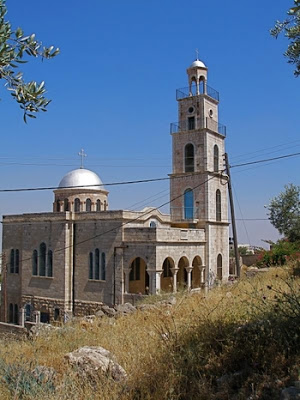
Nuns of the Greek Orthodox Convent of Sts. Mary, Martha, and Lazarus in Bethany have sent a letter to the President of the Palestinian Authority Mahmoud Abbas with the call to take appropriate measures against an escalation of attacks by criminals and Islamists, reports Sedmitza.ru.

The Convent is currently experiencing a time of troubles. Attacks, damage to property, thefts and robberies have become more frequent over recent months.

According to Fides, residents of Bethany—both Christians and Muslims—have visited the Convent as a sign of solidarity, to show that aggression is alien to the local populace.

"Someone wants us to go away,” writes Mother Abbess Eupraxia. “But we will not go anywhere".
The building of the separating wall between Israel and the Palestinian territories has considerably worsened the security situation in the region. Moreover, over recent months there has been a sharp rise in land prices in this region. A part of the convent's lands earlier belonged to a local Muslim family, which is now illegally trying to lay claim to them.


Monks in Egypt’s Lawless Sinai Hope to Preserve an Ancient Library

Fears of Muslim attacks following the "Arab Spring, " and the ouster of Egyptian President Mohammed Morsi have elevated safety concerns and caused the ancient monastery to step up its efforts to preserve its priceless collections.


Ladan Cher   Jul 22nd, 2013

Just as they have done for 17 centuries, the Greek Orthodox monks of St. Catherine’s Monastery in Egypt’s Sinai desert and the local Jabaliya Bedouins worked together to protect the monastery when the 2011 revolution thrust Egypt into a period of uncertainty. “There was a period in the early days of the Arab Spring when we had no idea what was going to happen,” says Father Justin, a monk who has lived at St. Catherine’s since 1996. Afraid they could be attacked by Islamic extremists or bandits in the relatively lawless expanse of desert, the 25 monks put the monastery’s most valuable manuscripts in the building’s storage room.
Their Bedouin friends, who live at the base of St. Catherine’s in a town of the same name, allegedly took up their weapons and guarded the perimeter.

The community’s fears of an attack were not realized, but the monks decided they needed a new way to protect their treasured library from any future threats. Last year, they began a program of digitally copying biblical scripts with the help of multispectral imaging specialists from around the world, while simultaneously renovating and modernizing the library itself. The Sinai library houses 1.8 million pages of script, including essential texts that document the early church. St. Catherine’s ranks high among the world’s preeminent Christian text collections: their Greek manuscripts are second in number only to the Vatican’s, and their hallmark Arabic and Turkish scrolls document the interaction between the monastery and the surrounding world of Islam over the centuries. The monastery’s project will create a digital library for scholars around the world. “The technology, the conservation — they are our protection. Many people are concerned about the safety of what we have here, so we have to make them sure that we are protecting our materials and appreciating our responsibility,” says Father Justin, the monastery’s librarian.

Security concerns are once again at the forefront after the July 3 military ouster of former President Mohamed Morsi and the violence that came in the wake of the change in the country’s leadership. Two days after Morsi’s ouster, the Egyptian army declared a state of emergency in Sinai after Islamist gunmen opened fire on the region’s el-Arish airport and several military checkpoints, killing several police officers and a soldier. St. Catherine’s is geographically vulnerable at the best of times, positioned as it is on a peninsula plagued by a security vacuum. Crimes like human trafficking and kidnappings along the Egypt-Israel border make Sinai one of Egypt’s most dangerous regions.

Father Justin acknowledges that the conservation efforts have been inspired by neighborhood insecurity. “Libraries are precious places where you can store the past in the present, and we are treating what happened to Cairo” — the riots, looting and violence that surrounded the revolution — “as a reminder that libraries are vulnerable, and right now they are more vulnerable than ever,” he says, sitting in his no-frills office in front of a MacBook Pro. He politely steps out to a dark room every few minutes to turn the page of an ancient manuscript so that an imaging crew from Greece can scan the palimpsest.

The two-plus years since the toppling of former President Hosni Mubarak have been unsettling for Egypt’s Christians, the majority of whom belong to the Coptic Church and account for a significant minority (up to 10%) of the country’s population. There have been violent clashes between Christians and Muslims, with deaths on both sides. St. Catherine’s has nevertheless maintained its track record of friendly relationships with its Muslim neighbors. The Greek Orthodox monks and the Jabaliya Bedouin tribe, who are the area’s majority residents, have shared land, food and friendly relations since the monastery was built centuries ago. The Jabaliya are believed to be descendants of the Byzantine soldiers who built the monastery in the 6th century, and many of them continue to guard the monastery as their own. “The monastery is a very special place for me and all Bedouins. It is a holy place for all religions. Our ancestors built St. Catherine’s,” explains Ramadan, 26, who has been a tour guide at the monastery since he was 15.

Another Bedouin resident, Faraj, just out of Friday morning prayers at a nearby mosque, adds: “[The Jabaliya and the monks] have been here for so long that we have grown together. We’ve been through times when we had to share our food and gardens. We share everything, we always have. There is even a mosque on the monastery. We don’t use it often anymore because our population is too big now, but it is a still a symbol of our friendly relationship.”


Eager to maintain similarly peaceful relations with all Egyptians, the monks hope their ongoing project will act as a reminder of the monastery’s historical bond with Egypt. “We have to present ourselves in a way to convince the Arabic-speaking world that we are a part of Egypt’s ancient history,” Father Justin says. In preserving their manuscripts, the monks of St. Catherine’s may also be preserving their way of life.

DO ISRAELI ZIONISTS THINK THE WEST BANK IS ALREADY A PART OF ‘SOVEREIGN ISRAEL’?

Minggu, 21 Juli 2013

According to a report in yesterday’s Sydney Morning Herald, Israeli Housing Minister, Yuri Ariel of the extreme right-wing Jewish Home Party, was quoted as saying with regards to the possibility of a settlement freeze during bilateral talks with Palestinians, ‘that he did not want to consider even a limited freeze’ adding: “It's inappropriate for the Jewish people, for the land of Israel and for a sovereign state. We are in favour of building as much as possible.”

Although he didn’t actually say it, Ariel got as close as one can to saying that the West Bank is a part of Israel without saying so explicitly.

Israel Katz, Israel’s Transport Minister and Likud Party member, also got close to saying it as well: “It would be immoral, un-Jewish and inhuman to freeze the lives of people and their children,” he told an Israeli radio audience.

It also seems Netanyahu himself let go a Freudian slip. He was reported by Greg Sheridan in The Australian as saying that the goals of the talks are about “Preventing a bi-national state . . . that would endanger the future of the Jewish state, and preventing the establishment of another Iranian-sponsored terrorist state within our borders.”

Within our borders? Whose borders?

Ramadhan Special 2013: PrimaDeli Hari Raya Promotion

Advertorial

Are you ready for some Hari Raya goodies?!

PrimaDeli is offering up some delicious and tasty treats for us this Hari Raya.
Now you can treat your guests and yourselves to a taste that we all love during Raya!

Look at all the goodies!!
PrimaDeli is known for its sweet treats especially during the festive seasons here in Singapore and it's no wonder too! Their treats are loved by so many for obvious reasons!

This Raya they have some special promo on for all of us.

Premium Pandan Chiffon, Butter Cake, Marble Cake & Lapis Surabaya
Deluxe Almond, Oatmeal Raisin & Chocolate Tart Cookies
Kuih Lapis
A staple during Raya is Kuih Lapis for sure!
It's definitely a skill that some of our parents, grandparents and generations before them definitely perfected over the decades. It's not easy okay!

Well, if you don't have the opportunity to bake your own Lapis this year, you'd be hard-pressed to find one that is better than PrimaDeli's out there in the shops. A 1kg Kuih Lapis should probably last through all the guests coming to visit plus save some for yourself of course! :P

But be sure to pre-order early okay.
This Kuih Lapis is so popular that you can expect it to sell out in advance.
(Kuih Lapis is only on sale from 27 July onwards)

Pillow Pineapple Tarts
Now here's something that is actually my favourite among all the treats from PrimaDeli if I may say so.

I'm quite a sucker for Pineapple Tarts. Since I was a kid, I'd sample the tarts at all the houses I visited but of course we're talking about the traditional round-shaped tarts. You know which ones I'm referring to right?
Let's face it. Hari Raya = Pineapple Tarts for sure.

Well I never really picked-up on these Pineapple Tarts that are kinda shaped like pillows until my Mum introduced me to them. She absolutely swore by them but of course I stuck to my traditional tarts.
Until one day I finally tried one and I was hooked! I guess Mum really knows best!!

These Pillow Pineapple Tarts from PrimaDeli are absolutely the bomb!
The crust is so light, flaky and buttery that it almost melts in your mouth. And then you reach the sweet centre made up of that delicious pineapple filling. YUMMY!

And it doesn't only look good in that picture by the way...


Thought we'd keep some for Raya but errr it's all gone!! Hahaha.
It's just so addictive that you pop one in your mouth and you just wanna take another one!

And my Mum absolutely loves the case it comes in!
Well I can guarantee you we will be getting a few more tins for Raya by the looks of it.
Hopefully we can save some for our guests :P

Here's the price list for all the items featured in this post;

Butter / Marble Cake - $5.70 per loaf
Premium Pandan Chiffon - $5.90 (Standard) / $10.90 (Large)
Lapis Surabaya (Original/Chocolate/Pandan) - $12.80
Kueh Lapis (approx 1.1kg) - $42.80
Pillow Pineapple Tarts - $14.80 per tin
Festive Cookies (Deluxe Almond / Oatmeal Raisin / Chocolate Tart) - $14.80 per tin

And if that's not enough - enjoy 15% ALL Hari Raya goodies all the way til 8 August!
PrimaCard holders enjoy an additional 3% off and Citibank cardholders 8% off and 10% Citi Rebate* (*Conditions apply)

If you're getting any of the treats please do invite me to your place for Raya but beware your Pillow Pineapple Tarts are in danger if I come over! Hahaha!

So drop by your nearest PrimaDeli now or call 6276 3333 if you have any enquiries.
More information on their site www.primadeli.com


How to Set Up an Icon Corner at Home

"Today, of course, when the television set ­– which is itself a kind of a window into the motley world of human passions – has taken the place of icons in the home, the purpose of the family icon, the tradition of common prayer at home, and the consciousness of the family as the “little Church” have been lost." —Serge Alexeev


Serge Alexeev — PRAVMIR

Quantity and quality are two different things. It would be naive to assume that the more sacred images there are in an Orthodox Christian’s home, the more pious his life. A disorganized collection of icons, reproductions, and religious wall calendars covering a significant amount of living space can often have a contrary effect on one’s spiritual life.

A poorly thought-out collection of icons can turn into something simple and meaningless, in which the prayerful purpose of the icon has no place whatsoever.

Nonetheless, it is essential to have icons in one’s home in sufficient numbers, but within reasonable limits.

In the past, whether on a farm or in the city, every Orthodox family’s home would always have a shelf with icons, or an entire home iconostasis, located in the most visible place. The place where the icons were installed was known as the front corner, the beautiful corner, the holy corner, God’s place, or the kiot.

For Orthodox Christians, an icon is not just a depiction of the Lord Jesus Christ, the Mother of God, the Saints, or events from Sacred and Church History. An icon is a sacred image, i.e., it is outside the realm of ordinary reality; it is not to be confused with ordinary daily life; and it is intended only for communion with God. Thus, the primary purpose of icons is prayer. An icon is a window from our world, the earthly world, into the world above. It is God’s revelation in form and color.
In this way, an icon is not simply a family relic to be passed on from generation to generation, but a holy thing that unites all family members during communal prayer – for prayer in common can take place only if those standing before the icons have mutually forgiven one another’s offenses and achieved unity.

Today, of course, when the television set ­– which is itself a kind of a window into the motley world of human passions – has taken the place of icons in the home, the purpose of the family icon, the tradition of common prayer at home, and the consciousness of the family as the “little Church” have been lost.

Therefore, an Orthodox Christian today might ask: What icons should I have in my home? How should they be arranged? Can I use reproductions of icons? What do I do with old, dilapidated icons?

Some of these questions merit an unequivocal answer, while others do not demand any kind of strict recommendations.

Where should one place icons at home?

In a free and accessible place.

The terse nature of such an answer is prompted by the realities of life, rather than by the absence of canonical requirements.

Of course, it is preferable to place icons on the eastern wall of the room, because the “East” as a theological concept has special significance in Orthodoxy.

  • And the Lord God planted a garden eastward in Eden; and there he put the man whom he had formed (Genesis 2:8).
  • O Jerusalem, look about thee toward the east, and behold the joy that cometh unto thee from God (Baruch 4:36).
  • Moreover the spirit lifted me up, and brought me unto the east gate of the Lord’s house, which looketh eastward (Ezekiel 11:1).
  • For as the lightning cometh out of the east, and shineth even unto the west; so shall also the coming of the Son of man be (Matthew 24:27).
But what should one do if there are windows or doors on the eastern side of one’s home? In that case, use the southern, northern, or western walls.

One should not combine icons with decorative objects of a secular nature, such as statuettes, various types of pictures, etc.

It is inappropriate to put icons on a bookshelf next to books having nothing in common with the Orthodox faith or that conflict with Christian teaching on love and charity.

It is absolutely impermissible to have icons next to posters or calendars depicting rock musicians, athletes, or politicians – the idols of the current age. This not only diminishes reverence for the holy images to an unacceptable degree, but also puts holy icons on par with the idols of the contemporary world.

The home icon corner can be decorated with live flowers. Traditionally, larger icons are often framed with towels. This tradition dates back to antiquity and has a theological basis. According to tradition, an image of the Savior miraculously appeared on a towel during His earthly life to help a suffering man. After washing His Face, Christ wiped His Face with a clean towel, on which an image of His Face appeared. The towel was sent to King Abgar, who was afflicted with leprosy, in the city of Edessa in Asia Minor. Upon healing, the ruler and his subjects adopted Christianity and the Image-Not-Made-By-Hands of Jesus Christ was affixed to a “permanent panel” and raised above the city gates.

In times past, August 29 (new style), the day the Church commemorates the translation of the Image Not-Made-By-Hands of our Lord Jesus Christ from Edessa to Constantinople in 944, was known among the people as the feast of the “canvas” or “linen Savior,” and in some places fabric and towels made of homespun yarn were blessed.

These richly embroidered towels were reserved for use in the icon corner. Likewise, icons were framed by towels for use during weddings and the Blessing of Waters. Thus, for example, after the service for the Blessing of Waters, when the priest sprinkled the icons with abundant Holy Water, people would wipe the icons with special towels that they would incorporate into the icon corner.

There is a tradition that, following the celebration of the Lord’s Entry into Jerusalem (Palm Sunday), pussy willow branches that have been blessed in church are kept near the icons until the following Palm Sunday.

It is customary that on Pentecost, the Day of the Holy Trinity, homes and icons are decorated with birch branches as a symbol of the flourishing Church, bearing the grace-filled power of the Holy Spirit.

Which icons should you have at home?

It is essential to have icons of the Savior and the Mother of God. The Image of the Lord Jesus Christ, which bears witness to the Incarnation and to the salvation of mankind, and of the Theotokos – the most perfect of those who have lived on earth, who was made worthy of deification, and who is venerated as more honorable than the Cherubim and beyond compare more glorious than the Seraphim – are an essential part of the Orthodox Christian home. The icon of Christ ordinarily selected for prayer at home is a waist-length depiction of Christ Pantocrator.


Those with room for a greater number of icons in the home may supplement their icon corner with depictions of various revered saints.

Russian Orthodoxy has a strong tradition of special veneration for St. Nicholas the Wonderworker; almost every Orthodox family has an icon of him. One should note that, together with the icons of the Savior and the Mother of God, the image of St. Nicholas the Wonderworker has always occupied a central place in Orthodox Christian homes. People revere St. Nicholas as a saint endowed with special grace. This stems in large part from the fact that, according to the Church’s Typikon, every Thursday, when the Church offers up prayers to the Holy Apostles, is also dedicated to St. Nicholas the Wonderworker, Archbishop of Myra in Lycia.

Among the icons of the Holy Prophets of God, that of the Prophet Elias holds a prominent place; prominent among the icons of the Holy Apostles is that of the Sts. Peter and Paul, the chiefs among the Apostles.

Among the images of martyrs for Christian Faith, those encountered most often are icons of the Holy Great Martyr and Trophy-bearer George and the Holy Great Martyr and Healer Panteleimon.
It is recommended to have depictions of the Holy Evangelists, of St. John the Baptist, of the Holy Archangels Gabriel and Michael, as well as icons of the Feasts, to make a home icon corner complete.
The selection of icons for one’s home is always an individual matter. The best person to help one make these choices is one’s priest – the family’s spiritual father – and it is to him, or to another clergyman, that one should turn for advice.

As for icon reproductions and color photographs, sometimes it makes more sense to have a good reproduction than a painted icon of poor quality.

An iconographer should maintain a very demanding attitude toward his work. Just as a priest does not serve the Liturgy without due preparation, the iconographer must approach his service with full awareness of his responsibility. Unfortunately, both in the past and today, one often encounters vulgar examples of images that bear no resemblance to icons. Thus, if a given depiction does not evoke a sense of piety and a sense of contact with the holy, or if it is theologically suspect and its technical execution is unprofessional, it would be best not to purchase such an item.

However, reproductions of canonical icons, mounted on a firm backing and blessed in church, can occupy a place of honor in the home iconostasis.

How and in what order should icons be arranged?
Are there strict rules in that regard?

In church, yes. As to the home prayer corner, we may limit discussion to a few principal rules.

For example, a collection of icons hung without a sense of symmetry, without a well thought-out arrangement, evokes a constant sense of dissatisfaction with the arrangement and a desire to change everything – something that often distracts from prayer.

It is likewise essential to remember the principle of hierarchy: for example, do not place an icon of a locally-venerated saint above an icon of the Holy Trinity, the Savior, the Mother of God, or the Apostles.

Just as on a classic iconostasis, the Icon of the Savior should be to the right, and the Mother of God to the left.

 What should be our attitude toward holy things?

As one of the attributes of God (Isaiah 6:3), holiness is also reflected in God’s saints and in physical objects. Therefore, reverence for holy people and sacred objects and images, as well as personal striving for authentic communion with God, are manifestations of a single order.

  • And ye shall be holy unto me: for I the Lord am holy (Leviticus 20: 26).

Family icons have always been held in particular reverence. Following baptism, an infant was brought before and icon and the priest or master of the house would read prayers. Parents blessed their children with an icon to pursue studies, to go on extended journeys, or to engage in public service. As a sign of their approval of a wedding, parents likewise blessed newlyweds with icons. Moreover, a person’s departure from this life took place in the presence of icons.

It is improper to have arguments or to engage in rowdy or otherwise improper behavior before the images of the saints.

One should instill proper reverence for holy images in children from a very early age.

What should you do if an icon’s condition has rendered it unfit for use and it cannot be restored?

Under no circumstance should such an icon, even one that has not been blessed, simply be thrown away. A holy item, even if it has lost its original appearance, should always be treated with reverence.

If the condition of the icon has deteriorated with age, it should be taken to church to be burned in the church furnace. If that proves impossible, you should burn the icon yourself and bury the ashes in a place that will not be sullied or disturbed, e.g., in a cemetery or under a tree in the garden.

The faces that look at us from icons belong to eternity. Gazing upon them, raise up your prayers to them, asking for their intercessions. We, the inhabitants of the earthly world, should never forget our Savior’s eternal call towards repentance, perfection, and the deification of every human soul.

Islam's Hatred of Holy Icons — and what that means for Persecuted Eastern Christians

Sabtu, 20 Juli 2013

Orthodox Church Iconostasis in the West Bank desecrated by Muslims

Introduction

One of the great sorrows — after the church attacks, murders, abductions, rapes and forced conversions — caused by Islamic persecution of Christians, whether in our own day or in centuries past, must be the defilement of holy icons by Muslims. Indeed, it is highly probable that the iconoclast heresy which rocked Christianity in the seventh and eighth centuries was triggered or accelerated by the brutal and sudden rise of Islam after the death of Muhammad in 632A.D.


Islam and Iconoclasm

Islamic 'icon' of Muhammad
and archangel Gabriel.
Islam is strongly set against images of any kind, although one may encounter in rare Islamic books depictions of Muhammad and his earliest companions, or Muhammad being visited by the spirit-being supposed to be the archangel Gabriel. But when it comes to Christian images of Jesus Christ, the Virgin Mary, or the saints, Islam is the "icon smasher" extraordinaire. ("Icon smasher" is a literal translation of "iconoclast.")

In all the Christian lands conquered by Muslims from the seventh century onwards, when churches were not completely destroyed, they were converted into mosques and the holy images painted over, or, if they were panel icons, simply hacked into pieces and/or burned.

Islam's innate hatred of Christianity's holy images helps account for the recent push to re-convert all the Hagia Sophia churches of Turkey into mosques, including and especially the great Hagia Sophia of Constantinople (Istanbul) built by Justinian in 537A.D. In converting the Great Church into a museum, the original frescoes and mosaics began to be restored, revealing once again the holy images of Christ, His Most Pure Mother, and the Saints. This is a serious affront to the Islamic mind, thus with the re-Islamicization of Turkey, we see special emphasis on once again covering (or perhaps destroying) all Christian images, most perfectly accomplished in converting all the Hagia Sophia churches into mosques.


Protestantism and Iconoclasm

There is no small irony in the fact that Protestant Christians also tend to be iconoclastic, rejecting the holy images which the Christian Church had created, embraced and sanctified from the first century onwards. Though perhaps a justifiable reaction against Roman Catholic use of statues, the Protestant rejection of holy icons is in fact a theological error which limits and impoverishes Protestant theology and its grasp of the Incarnation, as well as its actual worship. 

(Orthodoxy does not accept the use of statues in its churches as they are too realistic, too much of this world. Icons, in contrast, are deliberately "other-worldly," and are often called "windows into heaven." Even when they depict historical events in the life of the Savior or the Saints, these events are "transfigured" with the uncreated light beyond this world.)

Venerating an Icon
Orthodox converts from Protestantism are familiar with this issue, and are quick in grasping the essentials of proper icon use. “Worship is due to God alone,” the Church Fathers consistently affirm, whereas our veneration of an icon is imputed not to the wood and paint, but to the prototype in heaven. 

The Eastern Christian practice of making the sign of the Cross and bowing to kiss (venerate) icons is an essential physical aspect of Christian worship. Orthodox and Coptic Christians preserve intact the timeless certainty that worship to God must be performed by the entire person. Not with the mind alone, but with the body also do we show our love, adoration and worship of the Holy Trinity. 

Thus not only icons (which are visual and tactile), but incense (smell), prostrations and bows, and theologically rich hymnography (aural) according to the ancient rule of “Lex orandi, lex credendi” (St Vincent of Lerins) characterize traditional Christian worship.  

The pinnacle of Orthodox Christian worship is of course the receiving of the Holy Eucharist, the very Body and Blood of Christ, which sanctifies our entire being through the apparently mundane sense of taste. Thus the psalmist exclaims,

Taste and see that the Lord is good! —(Psalm 33:8, LXX)

And the Lord Jesus Christ teaches us,

Unless you eat the flesh of the Son of Man and drink His blood, you have no life in you. Whoever eats My flesh and drinks My blood has eternal life, and I will raise him up at the last day. For My flesh is food indeed, and My blood is drink indeed. He who eats My flesh and drinks My blood abides in Me, and I in him. As the living Father sent Me, and I live because of the Father, so he who feeds on Me will live because of Me. —(John 6:53-57)

The Greek word used for "eat" in these verses means literally to "gnaw" or "chew." No mere memorial or symbol here! Christ means that we are to literally eat His flesh and drink His blood. )

Thus all the senses, “All one’s strength,” as well as the mind and heart are to be fully engaged in worshipping the God of All. This is the first and greatest commandment:

“You shall love the Lord your God with all your heart, with all your soul, with all your mind, and with all your strength.” —(Deuteronomy 6:5, Matthew 22:37)

It was St John of Damascus in the eighth century who not merely defended the use of icons, but convincingly showed their necessity for Christian praxis, piety and worship. Because God the Word became Man and took on human form (literally becoming "enfleshed," which is what "incarnation" means), therefore He may be depicted in human form, as may His Most Holy Mother, the saints, and events in the life of Christ and His Church. The veneration of holy icons is thus a necessary and true aspect of authentic, timeless Christian worship.

This is so pure and simple a truth, that a child can grasp it. "Unless ye turn and become as little children..."  And children in the Orthodox Church naturally love and venerate the holy icons.

Just as the average home typically has many family photographs, so the Christian home should have holy images of the Family of God, the Church. Just as images are used in the secular world to teach, instruct, and depict historical events and heroes, so in the Church the holy icons present the Mystery of Faith in visual manner, yet, as stated above, in an other-worldly perspective, shining with an inner, transfigured light.

Tragically, by rejecting and denigrating Orthodox Christian iconography, Protestants are unwittingly siding with Islam, and implicitly denying the full meaning of the Incarnation.


The Islamification of the Bible

Protestantism commits a similar error in what Fr Stephen Freeman terms its "Islamification of Christianity." Protestantism has morphed the Bible into a sort of Christian Koran, as if God sent down the literal words of the Bible in direct revelation.

It is not the words of God which have been revealed to us. Rather it is Jesus Christ Himself, the Incarnate Logos, the Living Word of God, who is the most full and perfect revelation of God, "the image" — literally, "icon" — "of the invisible God," as the Apostle Paul writes in Colossians 1:15.

All of sacred scripture testifies to Him, and was written by numerous different people, the Old Testament over a couple of thousand years, the New Testament over only a few decades after the Crucified, Risen and Glorified Christ ascended to the right hand of the Father.

NEWS FLASH: The Bible did not come down out of heaven fully formed.

In the same way, the Gospel is not properly a "book," nor is it even "four books." St Paul speaks of the gospel in his letters, which were written well before the four gospels were written or known to the Church at large. (It is thought likely that Mark wrote his gospel — generally accepted to be the first of the four — around 70AD, nearly twenty years after 1 Thessalonians, the earliest of Paul's letters, written ca. 50-51AD. However, some scholars suggest that when Paul writes of "my gospel" in Romans 2:16, that he may be referring to the Gospel according to Luke, who traveled with Paul on his later missionary journeys, likely compiling and composing his Gospel and the Acts of the Apostles during this time.)

The Gospel is the saving good news of the Incarnation of Jesus Christ, the Word of God, in the flesh, bringing salvation and new life to mankind, enabling us to become "children of God" through Him (1 John 3:1), even to the point of becoming "partakers of the divine nature" (2 Peter 1:4).  In the theological language of the Church, this is termed theosis, or divinization. As St Athanasius of Alexandria boldly put it: "God became man so that man might become god."

The four gospels are thus the God-inspired accounts embraced by the Church within her Canon of Faith which properly testify to the Truth of The Gospel of Jesus Christ. The Living Word brings us the words of eternal life (John 6:68, 17:8), and it is the Word made flesh Himself  Who brings everything to us. Nothing is sent through an intermediary. Furthermore, by uniting us to Himself, he transforms us in an ontological manner. If we abide in Him, we are no longer of this world, just as He is not of this world (John 17:6, 14-18).

Jesus Christ is "the Way, the Truth and the Life" (John 14:6).  He is "the Light that was to come into the world" (John 1:9, 8:12), not the Bible. The Logos did not become incarnate to bring us a book — although we certainly rely on this Holy Book for the record of His life-giving words. And truly, all scripture is inspired by God and "profitable for doctrine, for reproof, for correction, for instruction in righteousness, that the man of God may be complete, thoroughly equipped for every good work" (2 Timothy 3:16-17). However, we must recall that when St Paul speaks of "the scriptures," he is referring to what we call the Old Testament. The New Testament did not yet exist.

The Scriptures are indeed God-inspired, and the Scriptures come from out of the womb of the Church. It is the Church which formed the New Testament, led and inspired by the Holy Spirit. This is part of the great synergia between God and Man. Thus we are not merely "People of the Book" (as Islam condescendingly calls Christians and Jews), but rather members of the Church, members of the theanthropic Body of Christ. And the Church is the Bride of Christ, the Temple of the Holy Spirit. Paul even calls the Church "the Pillar and Ground of the Truth" (1 Timothy 3:15).

The Logos became incarnate to bring Himself  to us, to unite us to Himself, and to usher us into Eternal Life in unending communion with the Holy Trinity, as Jesus prayed to His Father:

...That they all may be one, as You, Father, are in Me, and I in You; that they also may be one in Us, that the world may believe that You sent Me. And the glory which You gave Me I have given them, that they may be one just as We are one: I in them, and You in Me; that they may be made perfect in one, and that the world may know that You have sent Me, and have loved them as You have loved Me. —(John 17:21-23)

Islam distorts the meaning of the word "Gospel," positing that Jesus delivered the Injil (the Koranic term for the Gospel) as a book of God's words to his disciples (in a manner similar to how Muhammad supposedly delivered the Koran).

(Interestingly, Islam teaches that Jesus' disciples subsequently distorted his message in the Injil, which is why Allah sent Muhammad to correct everything, which is eerily similar to what Protestants teach happened between 100A.D. and the Reformation, that true Christianity disappeared, only to be recovered by the Protestant Reformation.  This is an alarming parallel indeed...)

Therefore, muddled Protestant theology, cut off from the sources of traditional Christianity, can be seen to be Islamified both in its distorted view of the Bible and the Gospel, as well as in its rejection of the holy icons.


Eastern Christians are 'True' Christians

The sad result is that Western Protestant Christians, though well-intentioned and sincere in so any ways in their faith, tend to have a very difficult time seeing Eastern Christians as "true" Christians. (I am deliberately leaving aside here any discussion of Chalcedonian vs. non-Chalcedonian communions...)

I remember ten years ago or so, being very saddened at meeting a young woman who was zealous to do missionary work in Russia because, as she put it, "All they have over there is the Orthodox Church."

Another young woman returning from a mission trip to Romania expressed her confusion to me as to why the impoverished Romanians she had met were so zealous to donate what little resources they had for the building and beautification of Orthodox churches there. She wanted desperately to liberate them from what she saw as false piety, and help them "know Jesus." I know she meant well, and is very faithful in her own way, but the Lord's lesson of the Widow's Mites was lost on her, and the Jesus she wanted to introduce the Romanians to was the American Jesus, the one who hates the holy icons, beauty, "high church" services, and everything Orthodox.

This unfortunate ignorance is a persistent affliction blinding American Protestants to the fullness of the Christian Faith and to their own destiny and calling in Christ. The Lord loves His Bride, the Orthodox Church, which is why He calls her to suffer for His sake, and why He is blessing the Russian Church to flourish in our own time, in accordance with the mysterious prophecy of St Seraphim of Sarov.


The Effect of Iconoclasm on Eastern Christians

With this background, I would like to express my concern that the innate rejection of Holy Orthodoxy and Eastern Christianity by Protestants may be a major factor in suppressing outcry in the United States against Muslim persecution of Christians in Egypt, Syria, Iraq, Iran, Libya, Tunisia, Eritrea, Nigeria, Sudan, Indonesia, Malaysia, Pakistan, and throughout the Islamic world.

In extreme cases, Protestants even condemn Eastern Christians (and Roman Catholics) as idolators because of their use of holy images, and therefore may secretly consider them as deserving of the "scourge of Islam" being visited upon them.  (As an historical aside, from the time of St Sophronius of Jerusalem in 637A.D., who called Christians to repent over their sins which had brought the Muslim attackers upon them, Eastern Christians have retained this sense of the rise of Islam as being allowed by God as a chastisement.)

With a double irony, the false "Prosperity Gospel" so popular in the United States actually fosters a sense within Evangelical circles that material prosperity (and lack of being persecuted) is proof of validation by God. This too is an Islamification of Christianity, being analogous to how the early Muslims interpreted Muhammad's battlefield successes, and after his death their own rapid expansion, as proof of God's favor and the truth of their religion. The Prosperity Gospel can ultimately lead to a condescending attitude towards Eastern Christians, and as with Protestant iconoclasm, suppresses U.S. support for Christians suffering under Muslim persecution.  In any case, Jesus clearly told us we would be persecuted if we follow Him, and he never promised earthly prosperity or glory.

We are seeing signs now that this unintentional suppression of concern and intervention for Eastern Christians suffering under Muslim persecution is beginning to change, as excellent organizations like International Christian ConcernMorning Star News, and others, offer broad reporting and support inclusive of Orthodox, Coptic, Assyrian, Chaldean and Catholic Christians. Important texts like Raymond Ibrahim's new book, Crucified Again - Exposing Islam's New War On Christians,  Mark Durie's The Third Choice, and others, help convey the causes, breadth and continuity of Islamic persecution of all Christians, and foster an informed concern especially for Eastern Christians in their fourteen-century long endurance of Islamic jihad and domination.

We may even hope that God may work through this wave of Islamic persecution of Eastern Christians to awaken and draw many souls into the fold of the timeless, unchanging Orthodox Christian Faith.
What's Become of Syria's Christian Sites?

Maaloula, where Aramaic is still spoken.

Magda Abu-Fadil - via OCP Media

As politicians debate the fate of Syria’s Christian minority, reportedly targeted by Muslim fundamentalists for supporting Bashar Al Assad’s regime, the country’s Christian sites seem to have been forgotten in the two-plus-year civil war.

“They cut off the head of the statue of Mary (Lady of the Two Worlds) in Syria’s Jisr El Shaghour region,” wrote Rev. Georges Massouh, a Lebanese Greek Orthodox priest, adding that it was still more acceptable than slaughtering human beings.

If the attack aimed to terrorize Christians, they will remain in Syria, whose every grain of soil is a witness to its Christianity, and will be martyrs of love, peace, and Christ’s eternal presence in them, he said this week in the daily Annahar.

Earlier this year, Tarek Al Abed wrote in Assafir, another Lebanese newspaper, that Christians and Muslims had coexisted in the Qalamoun region, noted for its Christian villages.

But the ongoing conflict has definitely taken a toll on Christians, their sites, and the language of Christ.
The Bible may have been translated into every language, but the tongue in which Jesus Christ would have preached is almost extinct, spoken by a few thousand people in Syria, mostly in the village of Maaloula.

Nobody can read or write Aramaic since there’s no alphabet and no visual record of it, I was told on a visit in 1991. Today it would be hard to quantify how many speakers remain, or how many have survived the fighting.

Linguistic scholars have disputed that contention, arguing that several hundred thousand people converse daily in Aramaic.

They agree that the “Western” dialect spoken in Syria, Lebanon and Palestine before the Muslim conquest, and thought to be the language Jesus used in spreading the gospel, is fast disappearing.
However, the “Eastern” dialect, the scholars argue, lives on – albeit in limited form – in Iraq, Iran, southeastern Turkey, and a sliver of some former Soviet republics.

One of the Semitic languages, spoken Aramaic of the “Western” variety is limited to the residents of Maaloula, a village 50 kilometers (31 miles) north of the Syrian capital Damascus.

It is also the popular language of people in the nearby villages of Jaba’deen and Najafa, although it has to compete with Arabic, the official language of Syria, as well as the closely linked Syriac and Hebrew.

Whatever records existed about the language were burned during the French colonial period, explained a Greek Orthodox nun at the St. Takla monastery in the craggy mountain village overlooking acres of once-rich agricultural land.

St. Takla’s monastery, one of the oldest in Christendom, dates back to the First Century A.D., and its founder was a disciple of St. Paul the apostle.

She was reportedly born to heathen parents in Iconia on the Greek-Turkish border and was persecuted for her beliefs by her ruler father.

Locals said St. Takla was fleeing her pagan father and his soldiers when she reached Maaloula. Its high mountains blocked her passage and it seemed she would be killed.

She is then said to have raised her hands in passionate prayer, which was answered when the mountain split, allowing her an escape route to safety.

St. Takla built a monastery, which contains her remains, on the spot from where she took flight.

For centuries it stood as a refuge for countless visitors and believers, convinced the water that oozes slowly from the rocky ceiling near the saint’s tomb had mysterious and curative qualities.

The word Maaloula originates from “Om Al Maalouleen” (mother of the afflicted), in reference to St. Takla’s healing powers, I was told, but evolved to signify passage or entryway.

The walls of the saint’s crypt are lined with valuable gifts donated by visitors who prayed to the young woman and had their prayers answered.

Situated between the steep rocky hills of the Qalamoun Mountains, Maaloula was most noted for its annual feast of the cross, when residents lit bonfires along various hilltops to mark the occasion and dance to the steady beat of drums.

I wonder if they still do, or dare to.

The village, a UNESCO World Heritage Site, is surrounded by caverns, once used by the early Christians, to hide from invading Roman legions, and the entire region was thought to be rich with treasures.

Villagers believed they were sitting on several layers of different civilizations, but little was done to promote the village’s historic and religious attractions for many years.

The once rich surrounding agricultural lands were also hit by several years of drought, leaving only patches of green on an otherwise dry mountain.

Many of Maaloula’s residents either migrated to the capital or ventured further afield to the United States and Brazil in the 1920s in search of greener pastures.

When I visited, the farmers produced enough of the village’s own consumption of wheat, tomatoes, apricots and peaches, but one member of each family invariably commuted to Damascus to supplement their income.

Another major Christian site in Syria is Our Lady of Saydnaya, a magnificent edifice on a hill overlooking the village by the same name.

It boasted a library of hundreds of valuable manuscripts housed in the 547 A.D. structure.

The convent is a Greek Orthodox establishment directly dependent on the Patriarchate of Antioch, with its seat in Damascus, and which owns several properties in Syria and Lebanon.

Legend has it that Emperor Justinian I of Byzantium, while crossing Syria with his troops en route to battle with the Persians, stopped in the Syrian desert to rest and search for water.

In the distance he spotted a gazelle, which he hunted with great energy until he was overcome with fatigue on a rocky hill.

The gazelle was headed to a spring of sweet water when it was suddenly transfigured into an icon of the Holy Virgin and shone with a bright light.

Stretching from the icon, according to the story, a hand reached out to the emperor, saying: “No, thou shalt not kill me, Justinian…but thou shall build for me a church, here on this hill.”


Among the sacred sanctuaries of the Greek Orthodox faith, the Saydnaya convent is second only to Jerusalem as a holy visiting place of pilgrimage in the Middle East.


Tags

Sidebar One