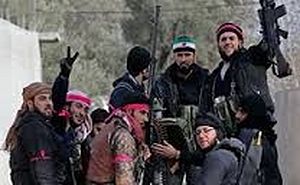
 Jihadista Performing Ethnic Cleansing of Christians in Syria Pravoslavie.ru - July 22, 2013 The president of the International Christian Union (ICU) Joseph Hakim believes that radical groups in the Syrian opposition are using the civil war to perform the ethnic cleansing of Christians, reports FRONTPAGEMAG.COM. The native Christians who are a minority in Syria at the present time "have to flee from their towns and villages" and seek refuge in less dangerous regions of the country and abroad. The ongoing bloodshed in Syria gives islamists an opportunity "to finish off what has survived after the Ottoman Turks", said the expert, referring to the genocide of Armenian Christians during the First world war. "I believe that what is happening should only be called a genocide," said Hakim. Hakim is complaining about the passiveness of the European community which is a witness of killing of Christians, beheading of priests, destroying of churches and kidnapping of bishops in Syria. In the expert’s view, it is a matter of coordinated efforts aimed at eradicating the Christian populations of Syria, Egypt, Iraq, Lebanon and the Middle East. |
Tampilkan postingan dengan label genocide. Tampilkan semua postingan
Tampilkan postingan dengan label genocide. Tampilkan semua postingan
Genocide against Christians in Syria seeks 'to finish off what has survived after the Ottoman Turks'.
Senin, 22 Juli 2013
"I believe that what is happening should only be called a genocide." —Joseph Hakim, President, International Christian Union (ICU)

Christians Flee Villages in Egypt’s North Sinai after Terrifying Murders
Rabu, 17 Juli 2013
Killings top months of kidnappings, attacks by Islamic extremist militants.
 |
| Detail of the corpse of Magdy Lamei. (Morning Star News photo from Facebook) |
CAIRO, Egypt (Morning Star News) – Christians in two villages in North Sinai, Egypt have fled for their lives after a priest was gunned down and a Christian businessman was abducted and killed, his decapitated body dumped onto a street.
On Thursday (July 11) the body of Christian businessman Magdy Lamei was found in the town of Sheikh Zuwayed. Suspected members of an unidentified Islamic extremist militant group had kidnapped him on July 6, and he was thought to have been killed on the first day of Ramadan, which in Egypt began on Wednesday (July 10).
At first glance, the abduction seemed to be just another of the kidnappings that have unsettled the area. But Yousef Soubhy, a Coptic Orthodox priest formerly in Rafah, said investigations indicated that wasn’t the case. The suspected militants purposely targeted a Christian leader, he said.
“He was a committed Christian, and he used to serve in the church, and he was active in his prayers and his ministry – he used to open his home for prayers,” Soubhy told Morning Star News. “It was obvious they didn’t kill him for the money.”
Soubhy said that when Lamei was killed, negotiations with the militants were still underway, and the ransom demand of 300,000 Egyptian pounds (US$42,545) was close to being collected.
“They didn’t wait for the money, they just killed him,” Soubhy said. “They killed him to terrorize the Christians.”
The grisly killing of Lamei and the lethal shooting of the Rev. Mina Aboud Sharubim, a Coptic priest, in Arish on July 6, were the final factors depleting three villages of Christians who have suffered months of attacks, threats and harassment. All Christians in Rafah and Sheikh Zuwayed have left, as have most of the Christians of Arish, sources said.
Some of those who left the three towns took only what they could carry and abandoned everything else; others said they hope to return once things cool down.
Fadiya Abdel Sayed, her husband and their three children left Rafah on Tuesday (July 9) to move back to their hometown of Assuit. They left with 13 other Christian families, broken and fearful over the killing of Sharubim in Arish.
“A lot of our neighbors had some of their family members that got kidnapped, and others were shot at,” Sayed told Morning Star News. “I left my work and property, and my husband left his trade and everything to come to our hometown until things calm down.”
There were about 130 Christian families that were living in Arish, but most of them have left, Sayed said.
Approximately 5,000 Egyptian Christians reside in Sinai, but the exact number of Copts that were living in Rafah and Sheikh Zuwayed is difficult to determine. In a recent statement, the Egyptian Institute for Personal Rights confirmed that all the Christians had left the two villages.
For years, North Sinai has been a hotbed of Islamic militancy, with one set of brazen attacks following another. Members of militant, Islamic extremist groups – some from the Palestinian Territories and elsewhere, most of them Egyptian – have attacked the North Sinai’s natural gas pipeline to Israel, captured or killed numerous policemen, raided security checkpoints and raided an international peacekeeping base and the regional headquarters of an Egyptian military security unit, among other targets.
The Egyptian Army is engaged in daily fighting with the militants. On Monday (July 15), militants attacked a busload full of factory workers with rocket-propelled grenades, killing one and wounding 17. The army has publicly speculated the attacking forces assumed the bus was full of police.
The militants have also run a campaign of intimidation against Christians in North Sinai. In January and February 2011, the Church of the Holy Family and St. George in Rafah was set on fire, with graffiti on the charred walls declaring the area “…a land of Islam. There is no room for Christians here.” In September 2012, after weeks of receiving threats to leave the area or be killed, several Coptic families fled when a group of militants raked a Christian business in Rafah with gunfire.
“The situation is horrible. It is insecure and unstable,” said Soubhy, now stationed in Arish. “There is a lot of fighting between the army and terrorist groups. We have been receiving a lot of threats, and after the killing of Father Mina and the murder of brother Lamei, who had his head cut off and left on top of his body, the feeling of fear has increased and things have gotten worse for Christians.”
Soubhy said he is unable to return to Rafah because the militants threatened to kill him. Because of Soubhy’s absence and the destruction of the church building there, for two years those wishing to attend services in Rafah have had to travel 45 kilometers (27 miles) to Arish.
On Sunday (July 14), leaders of the North Sinai parish announced that all the churches in the parish, including Arish, would be closed except for a very brief time in the morning.
‘Shadow war’ targets Christians in Syria
“I would like everyone to know that the West, in supporting the revolutionaries, is supporting religious extremists and helping to kill Christians.” —Fr. Halim Noujaim, Franciscan regional minister for Syria and Lebanon.

by John L. Allen, Jr - National Catholic Reporter via OCP Media
Christian minorities face threats in many parts of the convulsed Middle East today, but perhaps nowhere is the danger more acute than in Syria amid that nation’s bloody civil war.
An Internet video that went viral in late June, purportedly showing the beheading of three Christian clergymen by Syrian militants, was initially believed to capture the death of a Catholic priest named Fr. François Murad.
It turned out to be older footage of uncertain provenance, but that didn’t make Murad any less dead. According to officials of the Franciscan order that had given him refuge, Murad actually was shot to death on June 23 in the town of Gassanieh, in a convent where the 49-year-old monk was in hiding.
Reports suggest members of Jabhat al-Nusra, a militant Islamic group that’s part of Syria’s rebel alliance, killed Murad.
The killing represents the latest shock for Syria’s Christian community, which has become one of the primary victims of the violent standoff between rebel forces and the Assad regime.
Christians have long been an important minority in Syria, composing roughly 10 percent of the population of 22.5 million. The majority is Greek Orthodox, followed by Catholics, the Assyrian Church of the East, and various kinds of Protestants.
Syria was until recently a destination of choice for Christians fleeing the violence in Iraq, but all that changed with the eruption of civil war in 2011.
The kidnapping of two prominent Orthodox bishops in April underscored the new dangers. A group of armed men took the Syriac Orthodox bishop of Aleppo, Youhanna Ibrahim, and the Greek Orthodox metropolitan of Aleppo and Iskenderun, Boulos al-Yaziji, on the road to Aleppo. Their driver, a Syrian Orthodox deacon, was shot to death.
To date, the whereabouts of the bishops remain unknown.
Kidnapping Christians reportedly has become a growth industry. In late February, the website Ora pro Siria, operated by Italian missionaries in Syria, launched an emergency fundraising appeal called “Ransom a Christian.” The website said the going price for a kidnapped priest was in the neighborhood of $200,000.
It’s not just clergy who find themselves in harm’s way. In June, the Franciscan Custody of the Holy Land reported that a cluster of Christian villages along Syria’s Orontes River had been almost totally destroyed in the fighting, forcing thousands into hiding.
“Of the 4,000 inhabitants of the village of Ghassanieh, as just one example, the local pastor reports that no more than 10 people remain,” said Fr. Pierbattista Pizzaballa, director of the custody, adding that bombs had also seriously damaged a Franciscan monastery in Knayeh near the border with Lebanon.
As NCR went to press, a Greek-Catholic monastery in Qara was under assault by rebel forces. Officials of the Norbertine order told Vatican Radio they had lost contact with a 74-year-old Belgian missionary, Daniel Maes, living at the monastery.
In a July 1 opinion piece on National Review Online, religious freedom activist Nina Shea charged that a “shadow war” is being waged against Syria’s Christians. Shea pointed to the death of Murad and the fact that Islamist groups have begun setting up Shariah courts in areas of Syria under their control, charging Christians with a variety of alleged offenses under Muslim law.
In that context, some Syrian Christians have issued warnings about Western policies of arming Syria’s opposition.
“I would like everyone to know that the West, in supporting the revolutionaries, is supporting religious extremists and helping to kill Christians,” Fr. Halim Noujaim, the Franciscans’ regional minister for Syria and Lebanon, said after the execution of Murad.
The Obama administration recently announced the U.S. will provide small arms and ammunition to the rebels. Critics such as Noujaim charge that Assad’s fall could pave the way for either Iraq-style chaos or the Egyptian-style rise of an Islamist regime, in either case setting up Syria’s Christian minority for special hardship.
The Catholic Near East Welfare Association has issued an emergency appeal to support Syria’s Christians.
"It's A Pogrom." Head of Human Rights Federation describes situation in Egypt as "Ethnic Cleansing"
Naguib Gobarail, a Christian who heads the Human Rights Federation, described what has been happening as "ethnic cleansing."
"It's a pogrom. I have three sons I their late 20s, and they all emigrated with their families since Morsi took power. I've been threatened with death and my office burned three times."
A pretty good summary as to where things stand in Egypt at the moment.
COPTS FACE VIOLENT ONSLAUGHT IN WAKE OF MORSI OUSTER

by John Rossomando - July 16, 2013 - IPT via Breitbart News
Violence by Islamic radicals aimed at Egypt's Coptic Christian minority has increased in the wake of the military's July 3 ouster of President Mohamed Morsi.
Muslim Brotherhood supporters blame Coptic Orthodox Pope Tawadros II for supporting the Egyptian military's removal of Morsi.
"What is disturbing is the failure of the security apparatus to act -- which at times looks like collusion -- to protect citizens and their property who are being targeted on the basis of their religion, Ishak Ibrahim of the Egyptian Initiative for Personal Rights (EIPR) told Agence France Presse (AFP). "Copts are paying the price of the inflammatory rhetoric against them coming from some Islamist leaders and supporters of the former president, who accuse Coptic spiritual leaders of conspiring to foment army intervention to remove Dr Morsi."
The Daily Mail reported Saturday about a "frenzied" attack on an elderly Coptic priest who refused to disclose the location of a Muslim woman who had converted to Christianity. The priest is in hiding, and his family fears for their safety. His son, a shop owner, cannot appear in public since he was arrested and tortured by Egyptian police sympathetic to the Muslim Brotherhood.
Copts in the Sinai, which has been ravaged by Islamic extremists, have particularly found themselves vulnerable.
A mob wielding axes, clubs and tree limbs rampaged through the southern Egyptian village of Nagaa Hasan, attacking a Coptic businessman and his nephew, the Associated Press reported July 10. The mob hacked and beat the Copts, killing the businessman, identified as Emile Naseem, 41. He had been the village's most prominent proponent of ousting Morsi. His nephew survived with wounds to his shoulders and head.
The mob also burned dozens of Christian homes and stabbed three other Copts to death.
Magdy Habashi, a Christian merchant in the northern Sinai peninsula, was kidnapped and later found beheaded in a cemetery with his arms tied behind his back.
A priest reportedly was killed by Muslim gunmen who opened fire during a weekly trip to the grocery store. Fr. Youssef Souby Zaky, a friend of the slain priest, reluctantly left his church in the northern Sinai after it was ransacked and torched, telling the Daily Mail it was unsafe for Christians to remain in his town.
Naguib Gobarail, a Christian who heads the Human Rights Federation, described what has been happening as "ethnic cleansing."
"It's a pogrom. I have three sons I their late 20s, and they all emigrated with their families since Morsi took power. I've been threatened with death and my office burned three times."
Langganan:
Postingan (Atom)


