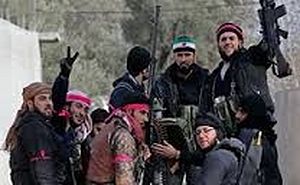
 Jihadista Performing Ethnic Cleansing of Christians in Syria Pravoslavie.ru - July 22, 2013 The president of the International Christian Union (ICU) Joseph Hakim believes that radical groups in the Syrian opposition are using the civil war to perform the ethnic cleansing of Christians, reports FRONTPAGEMAG.COM. The native Christians who are a minority in Syria at the present time "have to flee from their towns and villages" and seek refuge in less dangerous regions of the country and abroad. The ongoing bloodshed in Syria gives islamists an opportunity "to finish off what has survived after the Ottoman Turks", said the expert, referring to the genocide of Armenian Christians during the First world war. "I believe that what is happening should only be called a genocide," said Hakim. Hakim is complaining about the passiveness of the European community which is a witness of killing of Christians, beheading of priests, destroying of churches and kidnapping of bishops in Syria. In the expert’s view, it is a matter of coordinated efforts aimed at eradicating the Christian populations of Syria, Egypt, Iraq, Lebanon and the Middle East. |
Tampilkan postingan dengan label Syria. Tampilkan semua postingan
Tampilkan postingan dengan label Syria. Tampilkan semua postingan
Genocide against Christians in Syria seeks 'to finish off what has survived after the Ottoman Turks'.
Senin, 22 Juli 2013
"I believe that what is happening should only be called a genocide." —Joseph Hakim, President, International Christian Union (ICU)

What's Become of Syria's Christian Sites?
Sabtu, 20 Juli 2013
 |
| Maaloula, where Aramaic is still spoken. |
Magda Abu-Fadil - via OCP Media
As politicians debate the fate of Syria’s Christian minority, reportedly targeted by Muslim fundamentalists for supporting Bashar Al Assad’s regime, the country’s Christian sites seem to have been forgotten in the two-plus-year civil war.
“They cut off the head of the statue of Mary (Lady of the Two Worlds) in Syria’s Jisr El Shaghour region,” wrote Rev. Georges Massouh, a Lebanese Greek Orthodox priest, adding that it was still more acceptable than slaughtering human beings.
If the attack aimed to terrorize Christians, they will remain in Syria, whose every grain of soil is a witness to its Christianity, and will be martyrs of love, peace, and Christ’s eternal presence in them, he said this week in the daily Annahar.
Earlier this year, Tarek Al Abed wrote in Assafir, another Lebanese newspaper, that Christians and Muslims had coexisted in the Qalamoun region, noted for its Christian villages.
But the ongoing conflict has definitely taken a toll on Christians, their sites, and the language of Christ.
The Bible may have been translated into every language, but the tongue in which Jesus Christ would have preached is almost extinct, spoken by a few thousand people in Syria, mostly in the village of Maaloula.
Nobody can read or write Aramaic since there’s no alphabet and no visual record of it, I was told on a visit in 1991. Today it would be hard to quantify how many speakers remain, or how many have survived the fighting.
Linguistic scholars have disputed that contention, arguing that several hundred thousand people converse daily in Aramaic.
They agree that the “Western” dialect spoken in Syria, Lebanon and Palestine before the Muslim conquest, and thought to be the language Jesus used in spreading the gospel, is fast disappearing.
However, the “Eastern” dialect, the scholars argue, lives on – albeit in limited form – in Iraq, Iran, southeastern Turkey, and a sliver of some former Soviet republics.
One of the Semitic languages, spoken Aramaic of the “Western” variety is limited to the residents of Maaloula, a village 50 kilometers (31 miles) north of the Syrian capital Damascus.
It is also the popular language of people in the nearby villages of Jaba’deen and Najafa, although it has to compete with Arabic, the official language of Syria, as well as the closely linked Syriac and Hebrew.
Whatever records existed about the language were burned during the French colonial period, explained a Greek Orthodox nun at the St. Takla monastery in the craggy mountain village overlooking acres of once-rich agricultural land.
St. Takla’s monastery, one of the oldest in Christendom, dates back to the First Century A.D., and its founder was a disciple of St. Paul the apostle.
She was reportedly born to heathen parents in Iconia on the Greek-Turkish border and was persecuted for her beliefs by her ruler father.
Locals said St. Takla was fleeing her pagan father and his soldiers when she reached Maaloula. Its high mountains blocked her passage and it seemed she would be killed.
She is then said to have raised her hands in passionate prayer, which was answered when the mountain split, allowing her an escape route to safety.
St. Takla built a monastery, which contains her remains, on the spot from where she took flight.
For centuries it stood as a refuge for countless visitors and believers, convinced the water that oozes slowly from the rocky ceiling near the saint’s tomb had mysterious and curative qualities.
The word Maaloula originates from “Om Al Maalouleen” (mother of the afflicted), in reference to St. Takla’s healing powers, I was told, but evolved to signify passage or entryway.
The walls of the saint’s crypt are lined with valuable gifts donated by visitors who prayed to the young woman and had their prayers answered.
Situated between the steep rocky hills of the Qalamoun Mountains, Maaloula was most noted for its annual feast of the cross, when residents lit bonfires along various hilltops to mark the occasion and dance to the steady beat of drums.
I wonder if they still do, or dare to.
The village, a UNESCO World Heritage Site, is surrounded by caverns, once used by the early Christians, to hide from invading Roman legions, and the entire region was thought to be rich with treasures.
Villagers believed they were sitting on several layers of different civilizations, but little was done to promote the village’s historic and religious attractions for many years.
The once rich surrounding agricultural lands were also hit by several years of drought, leaving only patches of green on an otherwise dry mountain.
Many of Maaloula’s residents either migrated to the capital or ventured further afield to the United States and Brazil in the 1920s in search of greener pastures.
When I visited, the farmers produced enough of the village’s own consumption of wheat, tomatoes, apricots and peaches, but one member of each family invariably commuted to Damascus to supplement their income.
Another major Christian site in Syria is Our Lady of Saydnaya, a magnificent edifice on a hill overlooking the village by the same name.
It boasted a library of hundreds of valuable manuscripts housed in the 547 A.D. structure.
The convent is a Greek Orthodox establishment directly dependent on the Patriarchate of Antioch, with its seat in Damascus, and which owns several properties in Syria and Lebanon.
Legend has it that Emperor Justinian I of Byzantium, while crossing Syria with his troops en route to battle with the Persians, stopped in the Syrian desert to rest and search for water.
In the distance he spotted a gazelle, which he hunted with great energy until he was overcome with fatigue on a rocky hill.
The gazelle was headed to a spring of sweet water when it was suddenly transfigured into an icon of the Holy Virgin and shone with a bright light.
Stretching from the icon, according to the story, a hand reached out to the emperor, saying: “No, thou shalt not kill me, Justinian…but thou shall build for me a church, here on this hill.”
Among the sacred sanctuaries of the Greek Orthodox faith, the Saydnaya convent is second only to Jerusalem as a holy visiting place of pilgrimage in the Middle East.
Syria's Graphic Beheading Videos
Kamis, 18 Juli 2013
with links to videos being discussed...
by Raymond Ibrahim
Based on a widely circulated video and statements from the Vatican, it was believed that Fr. Francois Murad, a Catholic Syrian priest, was recently beheaded in Syria. It was not long before others “vigorously denied” the story, saying that the Christian priest was actually shot dead. And now that’s fast become the “big” news. For example, according to the Telegraph, “The footage, said to show Father Francois Murad, 49, as the victim in a brutal summary execution by foreign jihadists is likely to be an older video that bares no relation to the death of the Catholic priest. Father Murad ‘died when he was shot inside his church’ in the northern Syrian Christian village of Ghassaniyeh on June 23, three separate local sources, who did not wish to be named, told the Telegraph.”
by Raymond Ibrahim
Based on a widely circulated video and statements from the Vatican, it was believed that Fr. Francois Murad, a Catholic Syrian priest, was recently beheaded in Syria. It was not long before others “vigorously denied” the story, saying that the Christian priest was actually shot dead. And now that’s fast become the “big” news. For example, according to the Telegraph, “The footage, said to show Father Francois Murad, 49, as the victim in a brutal summary execution by foreign jihadists is likely to be an older video that bares no relation to the death of the Catholic priest. Father Murad ‘died when he was shot inside his church’ in the northern Syrian Christian village of Ghassaniyeh on June 23, three separate local sources, who did not wish to be named, told the Telegraph.”
 |
| Fr. Francois Murad, left; Still from video on right, man in red circle, was beheaded and believed to be the priest |
So apparently that makes it better? That seems to be the Telegraph’s take, for it continues: “Claims that Father Murad was one of two men to be decapitated by a foreign jihadist group went viral, with outrage expressed in blogs and articles worldwide.”
So now that he wasn’t beheaded, only shot dead inside his church, there’s no longer any call for “outrage”?
At any rate, welcome to the “distraction” tactic being exploited by the many elements trying to minimize the atrocities being committed by the jihadis—also known as the “Free Syrian Army” (FSA)—in Syria. Supporters of these jihadis exploit the fact that, in a time of war, as currently in Syria, news is not always reliable. They also claim that any news that portrays the Syrian government as the “good guys”—such as nonstop videos of the FSA committing atrocities—is just pro-Assad propaganda, that cannot be trusted (they never seem to see the flipside to this logic, that Western media can be disseminating false anti-Assad propaganda).
Thus, let’s not focus too much on the exact particulars—for indeed, exact information is not always clear—and rather acknowledge the big picture: namely that beheadings have become very common in Syria, even if we don’t always know the identities of those beheaded. But we do know who are doing the beheadings: al-Qaeda linked jihadis who are trying to transform Syria into a Sharia-ruling emirate.
Consider the video which some are now saying was not Fr. Murad—who was only shot (whew!) Whoever the men being beheaded are, what you are witnessing is the true face of the Syria “rebellion”—jihadis, most of them obviously foreigners. The ring leader appears perhaps Chechnyan, and can hardly speak proper Arabic (but one of the few phrases that he utters that is understandable is “we are enforcing the rules of Allah”). The bound men are then beheaded to wild cries of “Allahu Akbar!”
To appreciate the frequency of such beheadings, do a quick YouTube search with words like “Syria” and “beheadings,” and you will see any number of graphic videos of Syrians being beheaded by U.S.-backed jihadis. These are the videos that have still not been identified and removed by YouTube, but which likely soon will. Before them, there were many others that are now gone.
Among some of the ones currently up, are:
- A video of reportedly a Syrian policeman, having his head sliced off, to screams of Allahu Akbar; his head is then picked up and chucked to the ground.
- A video of reportedly a Muslim apostate to Christianity, either in Tunisia or Syria, also having his head sheared off to screams of Allahu Akbar.
- A video of a child, prodded by the Free Syrian Army, cutting the heads off of Syrian men for apparently being loyal to the Assad government.
- A video of the FSA making another child hack a man’s head off—again, to cries of Allahu Akbar.
- A video of the FSA tormenting and humiliating an obviously mentally-handicapped man, torturing another man, and at the very end beheading a third man—to cries of Allahu Akbar.
While strictly not a beheading video, let’s also not forget the video of an FSA fighter cutting out and biting into the heart of a dead soldier—the same video Russian president Putin rightly shamed the pr0-FSA West with. Before biting into the organs of his foe, the cannibalistic jihadi declares, “I swear to Allah, soldiers of Bashar, you dogs—we will eat your heart and livers! Allahu Akbar!”
So what’s to be learned by all this savage carnage, beheadings, cannibalism and what not? Those who wish to distract will insist that we cannot be sure of all the facts and circumstances—the identity of the executioners, the identity of the victims, the exact context, etc. They will nitpick and lose sight of the big picture. Hence the debate on whether Fr. Murad was beheaded or shot (incidentally, here’s a video of a man executed by jihadis in Syria by gunfire—again, to screams of “Allahu Akbar”; it’s not a whole lot better than the beheadings).
Even so, there is one thing we can be absolutely sure about—and it’s perhaps the most significant and existentialist point of these barbaric beheadings: they are all done in the name of the god of Islam; they are all accompanied by cries of distinctly Islamic slogans, most prominently, Allahu Akbar.
This speaks volumes, or at least it should. Even Muslims raping Coptic Christian girls, as in this video, shout this most distinctive of Islamic cries, first uttered by Islam’s prophet himself when attacking non-Muslims.
To understand the significance of all this, consider if Christian groups around the world started beheading people while screaming things like “In the name of the Father, Son, and Holy Spirit.” What would that say about Christianity?
What does it say about Islam?
Hence the true lesson of Syria’s beheading videos.
‘Shadow war’ targets Christians in Syria
Rabu, 17 Juli 2013
“I would like everyone to know that the West, in supporting the revolutionaries, is supporting religious extremists and helping to kill Christians.” —Fr. Halim Noujaim, Franciscan regional minister for Syria and Lebanon.

by John L. Allen, Jr - National Catholic Reporter via OCP Media
Christian minorities face threats in many parts of the convulsed Middle East today, but perhaps nowhere is the danger more acute than in Syria amid that nation’s bloody civil war.
An Internet video that went viral in late June, purportedly showing the beheading of three Christian clergymen by Syrian militants, was initially believed to capture the death of a Catholic priest named Fr. François Murad.
It turned out to be older footage of uncertain provenance, but that didn’t make Murad any less dead. According to officials of the Franciscan order that had given him refuge, Murad actually was shot to death on June 23 in the town of Gassanieh, in a convent where the 49-year-old monk was in hiding.
Reports suggest members of Jabhat al-Nusra, a militant Islamic group that’s part of Syria’s rebel alliance, killed Murad.
The killing represents the latest shock for Syria’s Christian community, which has become one of the primary victims of the violent standoff between rebel forces and the Assad regime.
Christians have long been an important minority in Syria, composing roughly 10 percent of the population of 22.5 million. The majority is Greek Orthodox, followed by Catholics, the Assyrian Church of the East, and various kinds of Protestants.
Syria was until recently a destination of choice for Christians fleeing the violence in Iraq, but all that changed with the eruption of civil war in 2011.
The kidnapping of two prominent Orthodox bishops in April underscored the new dangers. A group of armed men took the Syriac Orthodox bishop of Aleppo, Youhanna Ibrahim, and the Greek Orthodox metropolitan of Aleppo and Iskenderun, Boulos al-Yaziji, on the road to Aleppo. Their driver, a Syrian Orthodox deacon, was shot to death.
To date, the whereabouts of the bishops remain unknown.
Kidnapping Christians reportedly has become a growth industry. In late February, the website Ora pro Siria, operated by Italian missionaries in Syria, launched an emergency fundraising appeal called “Ransom a Christian.” The website said the going price for a kidnapped priest was in the neighborhood of $200,000.
It’s not just clergy who find themselves in harm’s way. In June, the Franciscan Custody of the Holy Land reported that a cluster of Christian villages along Syria’s Orontes River had been almost totally destroyed in the fighting, forcing thousands into hiding.
“Of the 4,000 inhabitants of the village of Ghassanieh, as just one example, the local pastor reports that no more than 10 people remain,” said Fr. Pierbattista Pizzaballa, director of the custody, adding that bombs had also seriously damaged a Franciscan monastery in Knayeh near the border with Lebanon.
As NCR went to press, a Greek-Catholic monastery in Qara was under assault by rebel forces. Officials of the Norbertine order told Vatican Radio they had lost contact with a 74-year-old Belgian missionary, Daniel Maes, living at the monastery.
In a July 1 opinion piece on National Review Online, religious freedom activist Nina Shea charged that a “shadow war” is being waged against Syria’s Christians. Shea pointed to the death of Murad and the fact that Islamist groups have begun setting up Shariah courts in areas of Syria under their control, charging Christians with a variety of alleged offenses under Muslim law.
In that context, some Syrian Christians have issued warnings about Western policies of arming Syria’s opposition.
“I would like everyone to know that the West, in supporting the revolutionaries, is supporting religious extremists and helping to kill Christians,” Fr. Halim Noujaim, the Franciscans’ regional minister for Syria and Lebanon, said after the execution of Murad.
The Obama administration recently announced the U.S. will provide small arms and ammunition to the rebels. Critics such as Noujaim charge that Assad’s fall could pave the way for either Iraq-style chaos or the Egyptian-style rise of an Islamist regime, in either case setting up Syria’s Christian minority for special hardship.
The Catholic Near East Welfare Association has issued an emergency appeal to support Syria’s Christians.
Arab Christians in Israel form New Political Party, Serve in IDF
Senin, 15 Juli 2013
I have frequently encountered Arab and Lebanese Orthodox who have a very low opinion of Israel and have tended to side with the "Palestinian" cause for statehood. This news report indicates some of that may be changing as the "Arab Spring" reveals the true colors of the Islamic world.

‘ARAB SPRING’ PROMPTS ISRAELI CHRISTIANS TO BREAK FROM MUSLIM POLITICAL PARTIES AND FORM NEW MOVEMENT
by Sharona Schwartz - The Blaze
Israel’s Christian Arabs have been nervously watching the persecution of the Christian populations in neighboring Egypt and Syria in the wake of the ‘Arab Spring’ protests. Those observations have prompted a group of Christian Arabs to form a new political party in Israel, one which encourages serving side-by-side with Jewish Israelis in the Israel Defense Forces.
The new party is called Bnai Brit HaHadasha which can be translated as the Sons of the New Covenant. The name can also be translated as Sons of the New Testament or Sons of the New Alliance. (In Hebrew, the New Testament is known as the Brit HaHadasha).
Christian Arabs in Israel in the past have been allied with Muslim-run political parties as they share the same language and often live in the same cities and towns.
The Times of Israel points out, “The effort is part of a growing assertiveness on the part of Christian Arabs in the wake of the Arab Spring, as they increasingly sound calls for an identity distinct from Israel’s broader Arab society, which is around 90% Muslim.”
As Muslim Brotherhood-aligned Mohammed Morsi was being ousted from power, the new party wrote on July 3rd on its Facebook page, “What happened in Egypt…should be a lesson!…It’s not just majority rule, it’s protecting the rights of minorities by the majority.”
Bashara Shlayan, 58, a ship captain from Nazareth, founded the new party. In an interview with Israel Hayom, he says he was motivated to enter politics not only because of the rapid changes gripping the region, but also because the Arab political parties in Israel predominantly serve the interests of Muslims and have a communist platform.
“People see what is happening now in Lebanon, Egypt and Syria. They understand where we are living. I tell them, ‘For 65 years we have given to the Arab communist parties; 65 years and they have done nothing!’ Give me three years, I will manage and solve their problems,” he says.
“Look at what the Arab parties have done. Just talking nonsense about nothing but communism; [MK Dov] Khenin and [MK Mohammad] Barakeh (Hadash/Communist Party), what have they done for us? They want us to disappear and are not acting according to the integrity of their country’s citizens,” Shlayan adds.
Further distinguishing himself from his Muslim Arab neighbors, Shlayan says he is an “Arab Christian in Israel who recognizes the land of Israel as belonging to the Jews.”
“Firstly we are completely Israeli, and then comes religion,” he says.
There is fierce opposition among Muslims living in Israel to serve in the IDF, a position that in the past influenced Christian Arabs to opt out. Though there is a draft in Israel, the government does not require Christian or Muslim Arab citizens to serve, due to possible conflicts of loyalty as family members may reside in Lebanon, Syria or other Middle Eastern countries still officially in a state of war with Israel.
Shlayan says he wants to change that, and helped his nephew and son enlist in the IDF. Since they were the trailblazers, that effort was a challenge.
“When I wanted my son to join the army we decided to create a forum for Christian enlistment. We also invited priests from the church to a conference we held in Nazareth Illit. One of them is the Church patriarch, Father Gabriel Nadaf [who has drawn the ire of Arab MKs recently for encouraging Christian Arab youth to join the IDF], who preferred [our way] and said we were right.”
Today Shlayan’s nephew is a major in a combat unit.
Because he publicly backed enlistment for Israel’s 130,000 Christian Arab citizens, Father Nadaf was “banned from entering Nazareth’s Church of the Annunciation, and was threatened with being fired from his position in Yafia. The tires of his car were punctured and a rag with bloodstains was laid at his doorstep,” writes the Times of Israel.
The Jerusalem Post reported that two Arab Members of Knesset (MKs) Bassel Ghattas and Haneen Zoabi wrote to the Greek Orthodox Church’s Patriarch Theophillis III demanding that Father Nadaf stop supporting Christian Arab enlistment or be fired from serving as priest in the town of Yafia in the Galilee near Nazareth.
“It’s unacceptable that Arab MKs should think that they can be Trojan horses in the Knesset and send letters of incitement against a Christian priest who encourages young Christians to enlist in the IDF,” Member of Knesset Miri Regev said in response.
Christian party founder Shlayan draws a comparison with the United States, saying, “You need to be like any citizen. If you were in America, you wouldn’t be an American? At least in Israel, those who stayed here [after the 1948 independence war] have been given the right to be a citizen and to integrate. But Israel’s first demand, which I support – and which needs to be understood – is that Israel is the home of the Jewish people.”
He also has harsh words for the current position of Israeli Arab parties which oppose the State of Israel, instead offering public support for Palestinian political ambitions.
“It’s stupidity. You can be against something pertaining to a certain matter, but the state does a lot of things, so be a partner! Don’t always be against. They think being against Israel is Arab nationalism, that it is the manly thing. But if you oppose this way of thinking, you are a traitor. This is what needs to be changed. It’s stupidity. So I demand that we, the Christians, be recognized as loyal citizens of the state,” he says.
According to Israel Hayom, Israel is the only country in the region where Christians are not fleeing to the West en masse.
Israel Hayom writes of the new party, “This is a historic turning point with profound and far-reaching consequences for Israeli society. If the party is successful, it will provide an alternative for that sector of Israel’s Arab population that seeks full partnership in Israeli society, and which sees a Jewish democratic Israel as its home.”
According to Maariv, 90 Christian high school graduates joined the IDF in recent months. That’s a three-fold increase compared with 2010.
Langganan:
Postingan (Atom)


