Orthodox Christians will also be required to remove our crosses or conceal them, and we will be told we cannot make the Sign of the Cross in public places. We will no longer be allowed to make processions outside of our church buildings as part of our divine services.
These are just the early warning signs. Gird your loins.
Student Ordered to Remove Cross Necklace at California College
Daily Caller via Pravoslavie.ru
Tampilkan postingan dengan label religious persecution. Tampilkan semua postingan
Tampilkan postingan dengan label religious persecution. Tampilkan semua postingan


Genocide against Christians in Syria seeks 'to finish off what has survived after the Ottoman Turks'.
"I believe that what is happening should only be called a genocide." —Joseph Hakim, President, International Christian Union (ICU)
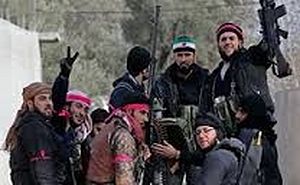 Jihadista Performing Ethnic Cleansing of Christians in Syria Pravoslavie.ru - July 22, 2013 The president of the International Christian Union (ICU) Joseph Hakim believes that radical groups in the Syrian opposition are using the civil war to perform the ethnic cleansing of Christians, reports FRONTPAGEMAG.COM. The native Christians who are a minority in Syria at the present time "have to flee from their towns and villages" and seek refuge in less dangerous regions of the country and abroad. The ongoing bloodshed in Syria gives islamists an opportunity "to finish off what has survived after the Ottoman Turks", said the expert, referring to the genocide of Armenian Christians during the First world war. "I believe that what is happening should only be called a genocide," said Hakim. Hakim is complaining about the passiveness of the European community which is a witness of killing of Christians, beheading of priests, destroying of churches and kidnapping of bishops in Syria. In the expert’s view, it is a matter of coordinated efforts aimed at eradicating the Christian populations of Syria, Egypt, Iraq, Lebanon and the Middle East. |
Orthodox Convent in Bethany being intimidated by criminals and Islamists
Related to this article and interview.
 Pravoslavie.ru - Bethany, July 18, 2013
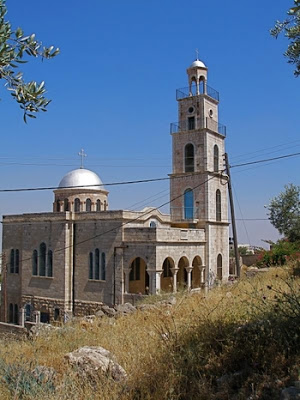
Nuns of the Greek Orthodox Convent of Sts. Mary, Martha, and Lazarus in Bethany have sent a letter to the President of the Palestinian Authority Mahmoud Abbas with the call to take appropriate measures against an escalation of attacks by criminals and Islamists, reports Sedmitza.ru. The Convent is currently experiencing a time of troubles. Attacks, damage to property, thefts and robberies have become more frequent over recent months. According to Fides, residents of Bethany—both Christians and Muslims—have visited the Convent as a sign of solidarity, to show that aggression is alien to the local populace. "Someone wants us to go away,” writes Mother Abbess Eupraxia. “But we will not go anywhere". The building of the separating wall between Israel and the Palestinian territories has considerably worsened the security situation in the region. Moreover, over recent months there has been a sharp rise in land prices in this region. A part of the convent's lands earlier belonged to a local Muslim family, which is now illegally trying to lay claim to them. |
Monks in Egypt’s Lawless Sinai Hope to Preserve an Ancient Library
Fears of Muslim attacks following the "Arab Spring, " and the ouster of Egyptian President Mohammed Morsi have elevated safety concerns and caused the ancient monastery to step up its efforts to preserve its priceless collections.

Ladan Cher Jul 22nd, 2013
Just as they have done for 17 centuries, the Greek Orthodox monks of St. Catherine’s Monastery in Egypt’s Sinai desert and the local Jabaliya Bedouins worked together to protect the monastery when the 2011 revolution thrust Egypt into a period of uncertainty. “There was a period in the early days of the Arab Spring when we had no idea what was going to happen,” says Father Justin, a monk who has lived at St. Catherine’s since 1996. Afraid they could be attacked by Islamic extremists or bandits in the relatively lawless expanse of desert, the 25 monks put the monastery’s most valuable manuscripts in the building’s storage room.
Their Bedouin friends, who live at the base of St. Catherine’s in a town of the same name, allegedly took up their weapons and guarded the perimeter.The community’s fears of an attack were not realized, but the monks decided they needed a new way to protect their treasured library from any future threats. Last year, they began a program of digitally copying biblical scripts with the help of multispectral imaging specialists from around the world, while simultaneously renovating and modernizing the library itself. The Sinai library houses 1.8 million pages of script, including essential texts that document the early church. St. Catherine’s ranks high among the world’s preeminent Christian text collections: their Greek manuscripts are second in number only to the Vatican’s, and their hallmark Arabic and Turkish scrolls document the interaction between the monastery and the surrounding world of Islam over the centuries. The monastery’s project will create a digital library for scholars around the world. “The technology, the conservation — they are our protection. Many people are concerned about the safety of what we have here, so we have to make them sure that we are protecting our materials and appreciating our responsibility,” says Father Justin, the monastery’s librarian.
Security concerns are once again at the forefront after the July 3 military ouster of former President Mohamed Morsi and the violence that came in the wake of the change in the country’s leadership. Two days after Morsi’s ouster, the Egyptian army declared a state of emergency in Sinai after Islamist gunmen opened fire on the region’s el-Arish airport and several military checkpoints, killing several police officers and a soldier. St. Catherine’s is geographically vulnerable at the best of times, positioned as it is on a peninsula plagued by a security vacuum. Crimes like human trafficking and kidnappings along the Egypt-Israel border make Sinai one of Egypt’s most dangerous regions.
Father Justin acknowledges that the conservation efforts have been inspired by neighborhood insecurity. “Libraries are precious places where you can store the past in the present, and we are treating what happened to Cairo” — the riots, looting and violence that surrounded the revolution — “as a reminder that libraries are vulnerable, and right now they are more vulnerable than ever,” he says, sitting in his no-frills office in front of a MacBook Pro. He politely steps out to a dark room every few minutes to turn the page of an ancient manuscript so that an imaging crew from Greece can scan the palimpsest.
The two-plus years since the toppling of former President Hosni Mubarak have been unsettling for Egypt’s Christians, the majority of whom belong to the Coptic Church and account for a significant minority (up to 10%) of the country’s population. There have been violent clashes between Christians and Muslims, with deaths on both sides. St. Catherine’s has nevertheless maintained its track record of friendly relationships with its Muslim neighbors. The Greek Orthodox monks and the Jabaliya Bedouin tribe, who are the area’s majority residents, have shared land, food and friendly relations since the monastery was built centuries ago. The Jabaliya are believed to be descendants of the Byzantine soldiers who built the monastery in the 6th century, and many of them continue to guard the monastery as their own. “The monastery is a very special place for me and all Bedouins. It is a holy place for all religions. Our ancestors built St. Catherine’s,” explains Ramadan, 26, who has been a tour guide at the monastery since he was 15.
Another Bedouin resident, Faraj, just out of Friday morning prayers at a nearby mosque, adds: “[The Jabaliya and the monks] have been here for so long that we have grown together. We’ve been through times when we had to share our food and gardens. We share everything, we always have. There is even a mosque on the monastery. We don’t use it often anymore because our population is too big now, but it is a still a symbol of our friendly relationship.”
Eager to maintain similarly peaceful relations with all Egyptians, the monks hope their ongoing project will act as a reminder of the monastery’s historical bond with Egypt. “We have to present ourselves in a way to convince the Arabic-speaking world that we are a part of Egypt’s ancient history,” Father Justin says. In preserving their manuscripts, the monks of St. Catherine’s may also be preserving their way of life.
What's Become of Syria's Christian Sites?
Sabtu, 20 Juli 2013
 |
| Maaloula, where Aramaic is still spoken. |
Magda Abu-Fadil - via OCP Media
As politicians debate the fate of Syria’s Christian minority, reportedly targeted by Muslim fundamentalists for supporting Bashar Al Assad’s regime, the country’s Christian sites seem to have been forgotten in the two-plus-year civil war.
“They cut off the head of the statue of Mary (Lady of the Two Worlds) in Syria’s Jisr El Shaghour region,” wrote Rev. Georges Massouh, a Lebanese Greek Orthodox priest, adding that it was still more acceptable than slaughtering human beings.
If the attack aimed to terrorize Christians, they will remain in Syria, whose every grain of soil is a witness to its Christianity, and will be martyrs of love, peace, and Christ’s eternal presence in them, he said this week in the daily Annahar.
Earlier this year, Tarek Al Abed wrote in Assafir, another Lebanese newspaper, that Christians and Muslims had coexisted in the Qalamoun region, noted for its Christian villages.
But the ongoing conflict has definitely taken a toll on Christians, their sites, and the language of Christ.
The Bible may have been translated into every language, but the tongue in which Jesus Christ would have preached is almost extinct, spoken by a few thousand people in Syria, mostly in the village of Maaloula.
Nobody can read or write Aramaic since there’s no alphabet and no visual record of it, I was told on a visit in 1991. Today it would be hard to quantify how many speakers remain, or how many have survived the fighting.
Linguistic scholars have disputed that contention, arguing that several hundred thousand people converse daily in Aramaic.
They agree that the “Western” dialect spoken in Syria, Lebanon and Palestine before the Muslim conquest, and thought to be the language Jesus used in spreading the gospel, is fast disappearing.
However, the “Eastern” dialect, the scholars argue, lives on – albeit in limited form – in Iraq, Iran, southeastern Turkey, and a sliver of some former Soviet republics.
One of the Semitic languages, spoken Aramaic of the “Western” variety is limited to the residents of Maaloula, a village 50 kilometers (31 miles) north of the Syrian capital Damascus.
It is also the popular language of people in the nearby villages of Jaba’deen and Najafa, although it has to compete with Arabic, the official language of Syria, as well as the closely linked Syriac and Hebrew.
Whatever records existed about the language were burned during the French colonial period, explained a Greek Orthodox nun at the St. Takla monastery in the craggy mountain village overlooking acres of once-rich agricultural land.
St. Takla’s monastery, one of the oldest in Christendom, dates back to the First Century A.D., and its founder was a disciple of St. Paul the apostle.
She was reportedly born to heathen parents in Iconia on the Greek-Turkish border and was persecuted for her beliefs by her ruler father.
Locals said St. Takla was fleeing her pagan father and his soldiers when she reached Maaloula. Its high mountains blocked her passage and it seemed she would be killed.
She is then said to have raised her hands in passionate prayer, which was answered when the mountain split, allowing her an escape route to safety.
St. Takla built a monastery, which contains her remains, on the spot from where she took flight.
For centuries it stood as a refuge for countless visitors and believers, convinced the water that oozes slowly from the rocky ceiling near the saint’s tomb had mysterious and curative qualities.
The word Maaloula originates from “Om Al Maalouleen” (mother of the afflicted), in reference to St. Takla’s healing powers, I was told, but evolved to signify passage or entryway.
The walls of the saint’s crypt are lined with valuable gifts donated by visitors who prayed to the young woman and had their prayers answered.
Situated between the steep rocky hills of the Qalamoun Mountains, Maaloula was most noted for its annual feast of the cross, when residents lit bonfires along various hilltops to mark the occasion and dance to the steady beat of drums.
I wonder if they still do, or dare to.
The village, a UNESCO World Heritage Site, is surrounded by caverns, once used by the early Christians, to hide from invading Roman legions, and the entire region was thought to be rich with treasures.
Villagers believed they were sitting on several layers of different civilizations, but little was done to promote the village’s historic and religious attractions for many years.
The once rich surrounding agricultural lands were also hit by several years of drought, leaving only patches of green on an otherwise dry mountain.
Many of Maaloula’s residents either migrated to the capital or ventured further afield to the United States and Brazil in the 1920s in search of greener pastures.
When I visited, the farmers produced enough of the village’s own consumption of wheat, tomatoes, apricots and peaches, but one member of each family invariably commuted to Damascus to supplement their income.
Another major Christian site in Syria is Our Lady of Saydnaya, a magnificent edifice on a hill overlooking the village by the same name.
It boasted a library of hundreds of valuable manuscripts housed in the 547 A.D. structure.
The convent is a Greek Orthodox establishment directly dependent on the Patriarchate of Antioch, with its seat in Damascus, and which owns several properties in Syria and Lebanon.
Legend has it that Emperor Justinian I of Byzantium, while crossing Syria with his troops en route to battle with the Persians, stopped in the Syrian desert to rest and search for water.
In the distance he spotted a gazelle, which he hunted with great energy until he was overcome with fatigue on a rocky hill.
The gazelle was headed to a spring of sweet water when it was suddenly transfigured into an icon of the Holy Virgin and shone with a bright light.
Stretching from the icon, according to the story, a hand reached out to the emperor, saying: “No, thou shalt not kill me, Justinian…but thou shall build for me a church, here on this hill.”
Among the sacred sanctuaries of the Greek Orthodox faith, the Saydnaya convent is second only to Jerusalem as a holy visiting place of pilgrimage in the Middle East.
Indonesia: Muslims Force Closure of 17 Churches
Jumat, 19 Juli 2013
AsiaNews — h/t Jihad Watch and The Religion of Peace
Jakarta (AsiaNews) - The Islamist pressures against Christian communities in Aceh "have become intolerable. Within a year, with non-existent legal pretexts, 17 house churches have been closed: these also include Catholic chapels. The islamization of the province continues , just as promised by the governor Abdullah. " It is the sense of the Annual Report published by IndonesianChristian.org, Protestant organization which monitors the situation of the Christian community in Indonesia.
The forced closure of places of worship and threats against Protestant congregations, says the text, "increase unabated. But this will only create tensions manipulated from the outside between the Christian and Islamic communities. The government must guarantee religious plurality and respect: or risk clashes and violence". Favor Bancin, of the Synod of the churches in Indonesia is of the same opinion, adding: "The behavior of local authorities is a potential threat to the tolerant atmosphere we see deteriorating over time."
Indonesia is the most populous Muslim nation in the world and, while guaranteeing the constitutional principles of religious freedom, it is more and more often the scene of attacks and violence against minorities, whether they are Christians, Ahmadi Muslims or of other faiths. In the province of Aceh - the only one in the Archipelago - the Islamic law (sharia) applies and in many other areas the influence of the Muslim religion in the lives of citizens is becoming more radical and extreme. In addition, certain rules such as the building permit - the infamous IMB - are exploited to prevent the building or close Christian places of worship, as is the case for some time in Bogor regency, West Java, for the faithful of the Yasmin Church.
Behind this upsurge is the current governor of Aceh, Zaini Abdullah, who has spent years in exile in Sweden for his activities within the Free Aceh Movement (GAM). During his election campaign, the Islamic politician stated several times that "he would not hesitate to apply the Koranic laws in the province." And a few months after his election his words have become reality.
For its part, the central government is seeking to curb this trend. Interior Minister Gamawan Fauzi has repeatedly warned that these activities "are not acceptable. Indonesia exercises a spirit of pluralism and must continue to do so. Tolerance must be guaranteed and the majority can not crush the minority violating their civil rights ".
The Time to 'Walk the Walk' is Upon Us
This brief essay is a wake up call to faithful Orthodox Christians. Worthy of sharing widely. As another Orthodox writer said some few decades ago:
Talk the Talk, Walk the Walk
by Archpriest John Moses - Pravmir
"Now one cannot be a half-hearted Christian, but only entirely or not at all." — Hieromonk Seraphim Rose (†1982)
 |
| Archangel Michael defeats Antichrist at the End of the Age |
by Archpriest John Moses - Pravmir
I knew that my question would cause some anxiety and concern, but by the look on the faces of the study group, I knew that I had hit a nerve.
We were in a Bible study on the book of Revelation. I pointed out that one of the things that we learn is that evil imitates the Good. Christ is the light of the world, and so the devil is an angel of light. Since Christ was incarnate in the world, taking on the reality of our physical existence, evil also seeks to make itself real and tangible.
So, Revelation shows us that one of the ways evil likes to incarnate is in governments and political systems. The Bible teaches that just as the Holy Spirit is in the world, the spirit of anti-Christ is also in the world. This spirit had incarnated itself many times in the governments of the world. Each time, God brought these systems to an end.
So, Revelation shows us that one of the ways evil likes to incarnate is in governments and political systems. The Bible teaches that just as the Holy Spirit is in the world, the spirit of anti-Christ is also in the world. This spirit had incarnated itself many times in the governments of the world. Each time, God brought these systems to an end.
Then I asked the question: “Many of you lived through the Great Depression. Many of you fought in World War II and the Korean and Vietnamese Wars. You have been good citizens and patriots. You have raised your children, paid your taxes, and attended church faithfully for many years. You say the Pledge of Allegiance with true pride and affection. Despite all of this, do you think that our country is becoming anti-Christ?”
The answer surprised me. “No, but we can begin to see signs of it.” I responded, “And if the time comes when it is clear to you that this has happened, that the United States has become completely anti-Christ, what will you do? Can you still pledge allegiance to such a government?
This is when the room was filled with puzzled and anxious faces. The year was 1992.
Most of my life, I have listened to people proclaim that they would be faithful to Jesus until the end. So many hymns were sung about how we would follow Jesus and there would be no turning back. We would carry the Cross of Jesus, and when He asked us, we would assure him that we are able.It was easy for us, you see, because at the time, we lived in the most secure and prosperous country in the world. We lived in peace behind the greatest and most powerful army in the world. Even more, we held on to the belief that America was fundamentally a Christian nation. At least our religious freedom was secure in the legal power of our founding documents. We came from a time when being a good Christian was synonymous with being a good citizen and we hope that this had remained the same.
How times have changed! Revisionist judges and courts have defined constitutional rights in ways that we could never have imagined. Under the dubious doctrine of the separation of Church and State, Christianity is being pushed out of the public realm. The government has grown to monstrous proportions, and now attempts to reach into every aspect of personal life. We learn that the right to privacy has not existed for many years. The IRS goes after conservative and Christian groups, and political opponents. The government ignores the Bill of Rights or finds a way to reinterpret it under the excuse that they are doing so to protect us.
We had the idea that we have inalienable rights and they are inalienable because they derive and are defined from a source outside of the state, God. Now the state is the only authority capable of defining what our rights are. And what the state has the power to give, it has the power to take away. Marriage, a social and religious institution that existed long before the founding of the American political system, is now defined by the state. So, under the rubric of equality, marriage is now granted to same-sex couples. How it will be further applied is anyone’s guess.
There have always been Christian martyrs, but in America we were far removed from it. I remember the first time I read the writings of Rev. Richard Wurmbrand. I was a little shocked to realize that someone in the modern world would actually face death for his faith. People died in the past for the Faith, surely not in these modern and sophisticated days. Today, we hear regular accounts of beheading, torture, kidnapping, and oppression inflicted upon Christian communities and believers.
[Which is why I diligently try to report here at least some of the horrible acts of evil committed by Islam against Christians, abhorrent though it is.]
If we believe that we are beginning to witness the incarnation of the spirit of anti-Christ in our American government; if we believe that the process of secularization is removing God from the public realm so that Christians are being treated as bigots or as being irrelevant; and if we believe that we are beginning to see worldwide rejection of Christianity that results in physical death and a large part of the world rejoices in it, then we have a sobering reality to face.
We have talked the talk. It’s been easy. We proclaimed that being Orthodox was to be “not of this world.” Of course, we proclaimed this while living comfortably in the world. Now, that comfort level is disappearing. The time is approaching when we will have to walk the walk.
To say that our Faith teaches that the only true marriage acceptable to God is between a man and woman will immediately mark us as bigots. We will be accused of hate speech when we say that our Faith teaches that homosexuality is not a lifestyle acceptable to God. I am not a prophet, but I can see a day when to refuse the state will result in the loss of tax exemption, and jail time for priests or pastors who refuse to do gay weddings. If the trend continues in America, it is possible that to proclaim Christ will mean facing a literal and physical death. (I know this seems unimaginable to Americans). What else can happen? I don’t know if it will happen in my lifetime. I do wonder what our children and grandchildren will face. Only God knows the answer.
[Already those who criticize Islam are branded in the media as bigots guilty of hate speech. Already Christians who seek to share the Gospel with Muslims are being arrested in accordance with Sharia Law—right here in America. To be a true Christian, that is, united with Christ, means to stand against the Evil One with one's very being. It is not for nothing that St John of Damascus identified the "superstition of the Ishmaelites... as a forerunner of the Antichrist."]
Whatever the present reality, whatever the pace of this ever-growing evil, it seems clear to me that the time to walk the walk is upon us. Let us pray with ever-greater urgency: “And keep us from the Evil One.”
Holy martyrs past, present, and to come, pray for us to have the courage and grace to walk the walk!
VIDEO: Coptic Church Destroyed by Muslim Extremists
Kamis, 18 Juli 2013
Harrowing footage, as the BBC news crew has to flee for their lives from Muslim extremists.
BBC News, h/t OCP Media
BBC News, h/t OCP Media
There has been a string of attacks on Christians in different provinces in Egypt since Mohammed Morsi was forced from office, with Coptic Christians saying they have been singled out for campaigning against him.
In the village of Dalga, near the central Egyptian city of Minya, a church was looted and destroyed and the priest, Father Ayoub Youssef, had to flee for his life.
He said Muslim neighbours helped his escape from the roof of his house.
''Had it not been for them, I would have been lynched," he said.
Ahmed Maher reports from Egypt.
Syria's Graphic Beheading Videos
with links to videos being discussed...
by Raymond Ibrahim
Based on a widely circulated video and statements from the Vatican, it was believed that Fr. Francois Murad, a Catholic Syrian priest, was recently beheaded in Syria. It was not long before others “vigorously denied” the story, saying that the Christian priest was actually shot dead. And now that’s fast become the “big” news. For example, according to the Telegraph, “The footage, said to show Father Francois Murad, 49, as the victim in a brutal summary execution by foreign jihadists is likely to be an older video that bares no relation to the death of the Catholic priest. Father Murad ‘died when he was shot inside his church’ in the northern Syrian Christian village of Ghassaniyeh on June 23, three separate local sources, who did not wish to be named, told the Telegraph.”
by Raymond Ibrahim
Based on a widely circulated video and statements from the Vatican, it was believed that Fr. Francois Murad, a Catholic Syrian priest, was recently beheaded in Syria. It was not long before others “vigorously denied” the story, saying that the Christian priest was actually shot dead. And now that’s fast become the “big” news. For example, according to the Telegraph, “The footage, said to show Father Francois Murad, 49, as the victim in a brutal summary execution by foreign jihadists is likely to be an older video that bares no relation to the death of the Catholic priest. Father Murad ‘died when he was shot inside his church’ in the northern Syrian Christian village of Ghassaniyeh on June 23, three separate local sources, who did not wish to be named, told the Telegraph.”
 |
| Fr. Francois Murad, left; Still from video on right, man in red circle, was beheaded and believed to be the priest |
So apparently that makes it better? That seems to be the Telegraph’s take, for it continues: “Claims that Father Murad was one of two men to be decapitated by a foreign jihadist group went viral, with outrage expressed in blogs and articles worldwide.”
So now that he wasn’t beheaded, only shot dead inside his church, there’s no longer any call for “outrage”?
At any rate, welcome to the “distraction” tactic being exploited by the many elements trying to minimize the atrocities being committed by the jihadis—also known as the “Free Syrian Army” (FSA)—in Syria. Supporters of these jihadis exploit the fact that, in a time of war, as currently in Syria, news is not always reliable. They also claim that any news that portrays the Syrian government as the “good guys”—such as nonstop videos of the FSA committing atrocities—is just pro-Assad propaganda, that cannot be trusted (they never seem to see the flipside to this logic, that Western media can be disseminating false anti-Assad propaganda).
Thus, let’s not focus too much on the exact particulars—for indeed, exact information is not always clear—and rather acknowledge the big picture: namely that beheadings have become very common in Syria, even if we don’t always know the identities of those beheaded. But we do know who are doing the beheadings: al-Qaeda linked jihadis who are trying to transform Syria into a Sharia-ruling emirate.
Consider the video which some are now saying was not Fr. Murad—who was only shot (whew!) Whoever the men being beheaded are, what you are witnessing is the true face of the Syria “rebellion”—jihadis, most of them obviously foreigners. The ring leader appears perhaps Chechnyan, and can hardly speak proper Arabic (but one of the few phrases that he utters that is understandable is “we are enforcing the rules of Allah”). The bound men are then beheaded to wild cries of “Allahu Akbar!”
To appreciate the frequency of such beheadings, do a quick YouTube search with words like “Syria” and “beheadings,” and you will see any number of graphic videos of Syrians being beheaded by U.S.-backed jihadis. These are the videos that have still not been identified and removed by YouTube, but which likely soon will. Before them, there were many others that are now gone.
Among some of the ones currently up, are:
- A video of reportedly a Syrian policeman, having his head sliced off, to screams of Allahu Akbar; his head is then picked up and chucked to the ground.
- A video of reportedly a Muslim apostate to Christianity, either in Tunisia or Syria, also having his head sheared off to screams of Allahu Akbar.
- A video of a child, prodded by the Free Syrian Army, cutting the heads off of Syrian men for apparently being loyal to the Assad government.
- A video of the FSA making another child hack a man’s head off—again, to cries of Allahu Akbar.
- A video of the FSA tormenting and humiliating an obviously mentally-handicapped man, torturing another man, and at the very end beheading a third man—to cries of Allahu Akbar.
While strictly not a beheading video, let’s also not forget the video of an FSA fighter cutting out and biting into the heart of a dead soldier—the same video Russian president Putin rightly shamed the pr0-FSA West with. Before biting into the organs of his foe, the cannibalistic jihadi declares, “I swear to Allah, soldiers of Bashar, you dogs—we will eat your heart and livers! Allahu Akbar!”
So what’s to be learned by all this savage carnage, beheadings, cannibalism and what not? Those who wish to distract will insist that we cannot be sure of all the facts and circumstances—the identity of the executioners, the identity of the victims, the exact context, etc. They will nitpick and lose sight of the big picture. Hence the debate on whether Fr. Murad was beheaded or shot (incidentally, here’s a video of a man executed by jihadis in Syria by gunfire—again, to screams of “Allahu Akbar”; it’s not a whole lot better than the beheadings).
Even so, there is one thing we can be absolutely sure about—and it’s perhaps the most significant and existentialist point of these barbaric beheadings: they are all done in the name of the god of Islam; they are all accompanied by cries of distinctly Islamic slogans, most prominently, Allahu Akbar.
This speaks volumes, or at least it should. Even Muslims raping Coptic Christian girls, as in this video, shout this most distinctive of Islamic cries, first uttered by Islam’s prophet himself when attacking non-Muslims.
To understand the significance of all this, consider if Christian groups around the world started beheading people while screaming things like “In the name of the Father, Son, and Holy Spirit.” What would that say about Christianity?
What does it say about Islam?
Hence the true lesson of Syria’s beheading videos.
Christians Flee Villages in Egypt’s North Sinai after Terrifying Murders
Rabu, 17 Juli 2013
Killings top months of kidnappings, attacks by Islamic extremist militants.
 |
| Detail of the corpse of Magdy Lamei. (Morning Star News photo from Facebook) |
CAIRO, Egypt (Morning Star News) – Christians in two villages in North Sinai, Egypt have fled for their lives after a priest was gunned down and a Christian businessman was abducted and killed, his decapitated body dumped onto a street.
On Thursday (July 11) the body of Christian businessman Magdy Lamei was found in the town of Sheikh Zuwayed. Suspected members of an unidentified Islamic extremist militant group had kidnapped him on July 6, and he was thought to have been killed on the first day of Ramadan, which in Egypt began on Wednesday (July 10).
At first glance, the abduction seemed to be just another of the kidnappings that have unsettled the area. But Yousef Soubhy, a Coptic Orthodox priest formerly in Rafah, said investigations indicated that wasn’t the case. The suspected militants purposely targeted a Christian leader, he said.
“He was a committed Christian, and he used to serve in the church, and he was active in his prayers and his ministry – he used to open his home for prayers,” Soubhy told Morning Star News. “It was obvious they didn’t kill him for the money.”
Soubhy said that when Lamei was killed, negotiations with the militants were still underway, and the ransom demand of 300,000 Egyptian pounds (US$42,545) was close to being collected.
“They didn’t wait for the money, they just killed him,” Soubhy said. “They killed him to terrorize the Christians.”
The grisly killing of Lamei and the lethal shooting of the Rev. Mina Aboud Sharubim, a Coptic priest, in Arish on July 6, were the final factors depleting three villages of Christians who have suffered months of attacks, threats and harassment. All Christians in Rafah and Sheikh Zuwayed have left, as have most of the Christians of Arish, sources said.
Some of those who left the three towns took only what they could carry and abandoned everything else; others said they hope to return once things cool down.
Fadiya Abdel Sayed, her husband and their three children left Rafah on Tuesday (July 9) to move back to their hometown of Assuit. They left with 13 other Christian families, broken and fearful over the killing of Sharubim in Arish.
“A lot of our neighbors had some of their family members that got kidnapped, and others were shot at,” Sayed told Morning Star News. “I left my work and property, and my husband left his trade and everything to come to our hometown until things calm down.”
There were about 130 Christian families that were living in Arish, but most of them have left, Sayed said.
Approximately 5,000 Egyptian Christians reside in Sinai, but the exact number of Copts that were living in Rafah and Sheikh Zuwayed is difficult to determine. In a recent statement, the Egyptian Institute for Personal Rights confirmed that all the Christians had left the two villages.
For years, North Sinai has been a hotbed of Islamic militancy, with one set of brazen attacks following another. Members of militant, Islamic extremist groups – some from the Palestinian Territories and elsewhere, most of them Egyptian – have attacked the North Sinai’s natural gas pipeline to Israel, captured or killed numerous policemen, raided security checkpoints and raided an international peacekeeping base and the regional headquarters of an Egyptian military security unit, among other targets.
The Egyptian Army is engaged in daily fighting with the militants. On Monday (July 15), militants attacked a busload full of factory workers with rocket-propelled grenades, killing one and wounding 17. The army has publicly speculated the attacking forces assumed the bus was full of police.
The militants have also run a campaign of intimidation against Christians in North Sinai. In January and February 2011, the Church of the Holy Family and St. George in Rafah was set on fire, with graffiti on the charred walls declaring the area “…a land of Islam. There is no room for Christians here.” In September 2012, after weeks of receiving threats to leave the area or be killed, several Coptic families fled when a group of militants raked a Christian business in Rafah with gunfire.
“The situation is horrible. It is insecure and unstable,” said Soubhy, now stationed in Arish. “There is a lot of fighting between the army and terrorist groups. We have been receiving a lot of threats, and after the killing of Father Mina and the murder of brother Lamei, who had his head cut off and left on top of his body, the feeling of fear has increased and things have gotten worse for Christians.”
Soubhy said he is unable to return to Rafah because the militants threatened to kill him. Because of Soubhy’s absence and the destruction of the church building there, for two years those wishing to attend services in Rafah have had to travel 45 kilometers (27 miles) to Arish.
On Sunday (July 14), leaders of the North Sinai parish announced that all the churches in the parish, including Arish, would be closed except for a very brief time in the morning.
‘Shadow war’ targets Christians in Syria
“I would like everyone to know that the West, in supporting the revolutionaries, is supporting religious extremists and helping to kill Christians.” —Fr. Halim Noujaim, Franciscan regional minister for Syria and Lebanon.

by John L. Allen, Jr - National Catholic Reporter via OCP Media
Christian minorities face threats in many parts of the convulsed Middle East today, but perhaps nowhere is the danger more acute than in Syria amid that nation’s bloody civil war.
An Internet video that went viral in late June, purportedly showing the beheading of three Christian clergymen by Syrian militants, was initially believed to capture the death of a Catholic priest named Fr. François Murad.
It turned out to be older footage of uncertain provenance, but that didn’t make Murad any less dead. According to officials of the Franciscan order that had given him refuge, Murad actually was shot to death on June 23 in the town of Gassanieh, in a convent where the 49-year-old monk was in hiding.
Reports suggest members of Jabhat al-Nusra, a militant Islamic group that’s part of Syria’s rebel alliance, killed Murad.
The killing represents the latest shock for Syria’s Christian community, which has become one of the primary victims of the violent standoff between rebel forces and the Assad regime.
Christians have long been an important minority in Syria, composing roughly 10 percent of the population of 22.5 million. The majority is Greek Orthodox, followed by Catholics, the Assyrian Church of the East, and various kinds of Protestants.
Syria was until recently a destination of choice for Christians fleeing the violence in Iraq, but all that changed with the eruption of civil war in 2011.
The kidnapping of two prominent Orthodox bishops in April underscored the new dangers. A group of armed men took the Syriac Orthodox bishop of Aleppo, Youhanna Ibrahim, and the Greek Orthodox metropolitan of Aleppo and Iskenderun, Boulos al-Yaziji, on the road to Aleppo. Their driver, a Syrian Orthodox deacon, was shot to death.
To date, the whereabouts of the bishops remain unknown.
Kidnapping Christians reportedly has become a growth industry. In late February, the website Ora pro Siria, operated by Italian missionaries in Syria, launched an emergency fundraising appeal called “Ransom a Christian.” The website said the going price for a kidnapped priest was in the neighborhood of $200,000.
It’s not just clergy who find themselves in harm’s way. In June, the Franciscan Custody of the Holy Land reported that a cluster of Christian villages along Syria’s Orontes River had been almost totally destroyed in the fighting, forcing thousands into hiding.
“Of the 4,000 inhabitants of the village of Ghassanieh, as just one example, the local pastor reports that no more than 10 people remain,” said Fr. Pierbattista Pizzaballa, director of the custody, adding that bombs had also seriously damaged a Franciscan monastery in Knayeh near the border with Lebanon.
As NCR went to press, a Greek-Catholic monastery in Qara was under assault by rebel forces. Officials of the Norbertine order told Vatican Radio they had lost contact with a 74-year-old Belgian missionary, Daniel Maes, living at the monastery.
In a July 1 opinion piece on National Review Online, religious freedom activist Nina Shea charged that a “shadow war” is being waged against Syria’s Christians. Shea pointed to the death of Murad and the fact that Islamist groups have begun setting up Shariah courts in areas of Syria under their control, charging Christians with a variety of alleged offenses under Muslim law.
In that context, some Syrian Christians have issued warnings about Western policies of arming Syria’s opposition.
“I would like everyone to know that the West, in supporting the revolutionaries, is supporting religious extremists and helping to kill Christians,” Fr. Halim Noujaim, the Franciscans’ regional minister for Syria and Lebanon, said after the execution of Murad.
The Obama administration recently announced the U.S. will provide small arms and ammunition to the rebels. Critics such as Noujaim charge that Assad’s fall could pave the way for either Iraq-style chaos or the Egyptian-style rise of an Islamist regime, in either case setting up Syria’s Christian minority for special hardship.
The Catholic Near East Welfare Association has issued an emergency appeal to support Syria’s Christians.
"It's A Pogrom." Head of Human Rights Federation describes situation in Egypt as "Ethnic Cleansing"
Naguib Gobarail, a Christian who heads the Human Rights Federation, described what has been happening as "ethnic cleansing."
"It's a pogrom. I have three sons I their late 20s, and they all emigrated with their families since Morsi took power. I've been threatened with death and my office burned three times."
A pretty good summary as to where things stand in Egypt at the moment.
COPTS FACE VIOLENT ONSLAUGHT IN WAKE OF MORSI OUSTER

by John Rossomando - July 16, 2013 - IPT via Breitbart News
Violence by Islamic radicals aimed at Egypt's Coptic Christian minority has increased in the wake of the military's July 3 ouster of President Mohamed Morsi.
Muslim Brotherhood supporters blame Coptic Orthodox Pope Tawadros II for supporting the Egyptian military's removal of Morsi.
"What is disturbing is the failure of the security apparatus to act -- which at times looks like collusion -- to protect citizens and their property who are being targeted on the basis of their religion, Ishak Ibrahim of the Egyptian Initiative for Personal Rights (EIPR) told Agence France Presse (AFP). "Copts are paying the price of the inflammatory rhetoric against them coming from some Islamist leaders and supporters of the former president, who accuse Coptic spiritual leaders of conspiring to foment army intervention to remove Dr Morsi."
The Daily Mail reported Saturday about a "frenzied" attack on an elderly Coptic priest who refused to disclose the location of a Muslim woman who had converted to Christianity. The priest is in hiding, and his family fears for their safety. His son, a shop owner, cannot appear in public since he was arrested and tortured by Egyptian police sympathetic to the Muslim Brotherhood.
Copts in the Sinai, which has been ravaged by Islamic extremists, have particularly found themselves vulnerable.
A mob wielding axes, clubs and tree limbs rampaged through the southern Egyptian village of Nagaa Hasan, attacking a Coptic businessman and his nephew, the Associated Press reported July 10. The mob hacked and beat the Copts, killing the businessman, identified as Emile Naseem, 41. He had been the village's most prominent proponent of ousting Morsi. His nephew survived with wounds to his shoulders and head.
The mob also burned dozens of Christian homes and stabbed three other Copts to death.
Magdy Habashi, a Christian merchant in the northern Sinai peninsula, was kidnapped and later found beheaded in a cemetery with his arms tied behind his back.
A priest reportedly was killed by Muslim gunmen who opened fire during a weekly trip to the grocery store. Fr. Youssef Souby Zaky, a friend of the slain priest, reluctantly left his church in the northern Sinai after it was ransacked and torched, telling the Daily Mail it was unsafe for Christians to remain in his town.
Naguib Gobarail, a Christian who heads the Human Rights Federation, described what has been happening as "ethnic cleansing."
"It's a pogrom. I have three sons I their late 20s, and they all emigrated with their families since Morsi took power. I've been threatened with death and my office burned three times."
Langganan:
Postingan (Atom)


